
New Wall Hanging Underway and More

These are cute, aren’t they!?! I used bedspread cotton with a number 2 steel hook. They are for a Black, White, and Red-All-Over wall hanging that I have been planning for a while. Hope to post the beginnings of that pretty soon.
I have a little sewing to do. We stopped by Hobby Lobby on a trip to Austin and bought fabric for a couple of school outfits for Eva, and an outfit for Ella. Fabric is so much fun. I wish I could sew all their clothes, but then there wouldn’t be time for knitting and crocheting!
New Yarn in the House and Kids’ Projects
Last week we were in the neighborhood of Twisted Yarns, and lovely yarn shop in Spring, Texas. Naturally, we dropped by. I need a particular color of light violet, maybe mauve, for a class sample. Manos del Uruguay had the perfect shade, so I had to buy it.
I couldn’t resist the temptation of Nicki Epstein’s new book, Knitted Flowers. It’s beautiful and imaginative, as all her books are. This yarn, a merino tape, appealed to the very fiber of my being! It stunned me. “Mom, buy it!” Eva said. Who am I to argue with such wisdom? So here it is, making me happy just because it exists. It is called Tagliatelli, color “Burnt Ochre,” by Colinette.


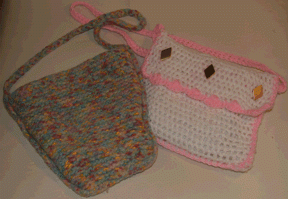
The children of the house have been busy. Eva (almost 11 years old) crocheted this pretty purse and lined it. She also finished a felted purse project that has been dragging on for too long. It is garter stitch, and it grew wider as she knitted. Fortunately, the accidental shaping was perfect for this little bag. She was fascinated, as I knew she would be, at the felting process. The bag is about 2/3 of its original size.
Three-and-a-half year old Ella wants to knit so much! She has made up her own brand of knitting and crocheting.. She “knitted” a sweater for a tiny teddy bear by winding the yarn around him. Here’s her latest “crochet” creation, made all by herself. It’s a fairy lollipop.

Catching Up with Project Spectrum

Where did June go? For that matter what happened to May? Can it be possible that we’re more than halfway through July? Project Spectrum has gotten way ahead of me, which is odd, since I love color and think about it and study it and experiment with it almost every day.
Let’s see if I can recover. Alright. May’s color was green. In May, I made a workshop sample that had a lot of green in it. Purple is July’s color, and I’m declaring the Snowflake wall hanging my July project.
I’ve always wanted to recycle blue jeans into a wall hanging or garment. A dear neighbor recently gave me a pile of old jeans. This must be a sign that it is time to get on with my jeans project! I’ve been sorting and trimming them. The buttons are so great, with the jeans logo stamped into them, that I saved them. Here they are, in recognition of Project Spectrum and my someday, sometime blue jeans project.
Starching Leaves
My crocheted leaves looked like green squiggles. You had to stretch them out and hold them with three hands to see their shape. The sunflower petals were wiggly and bent even after a steam treatment. Hmm… Wonder if I could starch them? Wouldn’t hurt to try.

I mixed up some laundry starch, about half the strength of the recipe for the doilies (see One Way to Starch a Doily). I dunked the pieces, squeezed them out, pinned them to cardboard, and let them dry in the sun. It worked! The wool leaves are still flexible, and they feel fine—you know, still soft. The synthetic leaves (Kelly green) dried a lot stiffer than the woolen ones. Maybe they soaked up more starch. Don’t know.
The sunflower is heavier than the leaves and the stitches are a lot looser. So far, the petals are staying straight. A couple of them look like they might squiggle back up any minute. Next time I do this flower, I’m going to use thinner yarn and tighter stitches. And maybe stronger starch.
Ludlum and Button Sewing

Fantastical situations, heartless undercover men with heart, impossibly beautiful women (who help the heartless men discover their hearts), long and undoubtedly accurate technical descriptions of military equipment, incredibly complex conspiracies that require hundreds of people to operate with unerring efficiency and keep their mouths shut, formidable enemies who have terrible aim: such are the elements of a Robert Ludlum novel. Oh, how I love to listen to these novels on tape.
The tape of the moment is The Janson Directive, read by actor Paul Michael, who is good at accents: Russian, Indian, several kinds of British, New England, and more. It’s fun to hear him. The reading lasts through 28 sides of audiotape, and it’s a good thing, because the Snowflake wall hanging had lots of buttons and beads for me to sew. I also had to do quite a bit of seam reinforcement and some repair to the knitting by hand.
Now the wall hanging is as finished as it is going to get. I experimented with more buttons, but it is at a point where more embellishment detracts from the effect. It’s time to quit. Hurray!
I’m declaring this wall hanging as my July Project Spectrum contribution. July’s color is purple.

In other creative doings around the house, 10-year-old Eva gathered burr oak acorns and gave them faces and hair. She called them ‘talking heads,’ and told her sister that if she were lonely, she could talk to one and it would make her feel better.
One Way to Starch a Doily


These little pieces came in a tin I bought at an antique store. They were dirty and smelled of pipe tobacco. These scans show before cleaning and starching and after cleaning and starching. Isn’t the difference amazing?!
Careful starching is part of the finishing process for these decorative pieces and also for small things like bookmarks and crocheted snowflake ornaments. It is some trouble, but thank goodness, you only need to starch after a piece has been finished or washed.
My first step was to wash those dingy things. Ivory Liquid is a favorite gentle cleanser among a lot of textile and fiber folks. But I didn’t have any Ivory, so I washed these in shampoo. They still looked dirty, so I tried a brightening wash:
- Half-fill the bathroom sink. Add a handful of borax powder.
- Swish doilies around and let them soak a few minutes.
- Rinse in running water.
- Run another half-sink or water. Add about 2 Tablespoons of lemon juice.
- Soak and swish doilies again.
- Rinse again in running water.
- Lay flat to dry, preferably in sunshine.
As you read the next steps, take it from someone who has learned this lesson in the school of experience: lazy methods produce inferior results. With that in mind, prepare for starching:
- Lightly stretch the doily and measure its dimensions. For a round doily, measure across. For a square, rectangular, or oval doily, measure length and width.
- On a piece of parchment paper or wax paper, use a pencil or waterproof pen to draw the shape of the doily to be starched. Leave a wide border around the drawing. For round doilies, trace around a plate or platter that is about the right size. For squares, rectangles, and ovals, use a ruler to measure and draw an outline.
- If your round doily is obviously divisible into quarters, fold your circle drawing into quarters, with the center of the fold at the center of the circle. This will give you guidelines for evenly pinning your doily.
- Tape the drawing to a piece of cardboard. Find a bunch of pins.
You can use your eye to estimate the lines if you want, but I guarantee you will have a better product if you take the time to draw the lines.

Now prepare the starch. I use Faultless powdered starch. My supermarket has these old-fashioned boxes alongside the spray starches. These proportions will make your doily fairly stiff, as you can see in the photo below. There’s plenty here to do several medium sized doilies.

1/2 c water (4 fluid oz.)
1 1/2 Tablespoons (1 T + 1-1/2 tsp) laundry starch
1/4 c water
1 c cool water
Mix starch powder into 1/4 cup cool water until smooth. In a small saucepan, bring ½ cup water to a boil. Remove from heat and slowly stir starch mixture into hot water. Add cool water and mix well. Let cool.
OR make sugar starch with 1 part water, 2 parts sugar. In a saucepan, heat and stir water and sugar until solution is clear. No need to boil. Let cool.
Make doily wet and squeeze out excess water. Put doily into the starch solution (laundry starch or sugar starch). Let stand for a few minutes. Remove from starch solution and squeeze out excess.
Pin doily onto the cardboard, using the drawn lines as a guide. My drawn circle was a fraction too small, so I pinned each loop just outside the line all around. For best results, pin each point or loop in place. Take time to straighten and smooth each flower petal. (Go back to the top and compare the flower centers, before and after.)

In the picture marked “NO,” the loops have not been pinned. They’ll dry like that, and the outside of the doily will look crumpled. You can see the penciled line I used for a guide.

In the picture marked “YES,” I pinned all the loops. It takes longer, but the results are worth it.

Here are my three all pinned and drying.
Let the piece dry completely. Remove the pins, and enjoy your beautifully finished doily!

A few more notes:
Do not iron flat doilies. There’s no need to do that, in spite of information presented on other websites.
For doilies with large ruffles, make some kind of support for the ruffles, like cones made by rolling paper and taping. Once the ruffled doily is dry, you may need to touch up the ruffles with the iron. I’m talking about the ruffles that stand a couple or three inches high. These doilies were popular at one time, I guess when people had more time for starching!
I have read about spray starching doilies and similar pieces. I have never done this. My concern is that the spray starch wouldn’t penetrate the piece like the liquid starch does.
In my experience, sugar starch does not attract ants. I sugar-starched some snowflakes over twenty years ago, and they have been ant-free all this time.
Commercial fabric stiffeners are available at craft stores, under brand names like Stiffy. They are like white glue, and they do a good job. I think pieces stiffened with commercial stiffeners have a bit of a translucent look, almost as if they are still wet. Starch and sugar give a fine, dry-looking finish to cotton thread.
Taos Wool Festival Workshops 2006
Old links have been removed.
Only three months until the Taos Wool Festival and workshops begin! Workshops run October 3 through 10, with a break for the Wool Festival itself on October 7 and 8. Workshops are kept small on purpose, so participants can have more interaction with the teacher. Read workshop descriptions here. Old links have been removed.

Lynn Vogel, author of The Twisted Sisters Sock Workbook, will be teaching about spinning and color for three days. Her book is such a visual treat, I can only imagine that her workshop will be greatly satisfying. Assisted by Sandy Sitzman, Lynn will cover color spinning techniques to show you how many different yarns you can spin from one hand painted roving and how to use colors in yarn design. Then participants learn color knitting techniques: intarsia, Fair Isle, mosaic, using these yarns, including how to graph your own designs as you go. Use the link above to read the entire class description.
I’m teaching, too. “Color Composure for Knitters and Crocheters” is about learning to use color through observation and experimentation. No theory allowed! No color wheels allowed!

These photos are examples of what I’m talking about. I loved the look of the blue, magenta, and yellow wildflowers growing together in the field. After looking carefully, I realized that these colors were joined by a green background. The colors I observed in nature inspired the sample. In my workshop you get a whole day of color and inspiration and tools for studying color on your own.
I’m also doing a button workshop, where we’ll make felted buttons, embroidered buttons, beaded buttons, and polymer clay buttons. Pics are posted at the Taos Wool Festival Workshops Yahoo Group. If you would like to keep up with workshop doings, please join.

4H Clothing Camp, Buttons

We had a great, great day making buttons at the 4-H Clothing Camp. The girls chose clay colors and got with some button-making. Here is one of the five trays of buttons we made and some close-ups, so you can admire the work of these Erath (and surrounding counties) 4-H participants.


4H Clothing Camp, Pillows and Blankets

We didn’t know what to expect from the Erath County 4H Clothing Camp this morning. By the afternoon, Eva declared it “Fun. Really fun. More fun than basketball camp!”
Here she is, sewing. I helped her thread the machine and recover from small sewing setbacks. At the end of the day, she said, “Mom, I’m addicted to sewing!”

Over thirty girls came to sew today. Their first project was a picture pillow. Participants e-mailed a photo ahead of time. Donna White, our coordinator, printed the photos on paper-backed cotton, made especially for going through an ink-jet printer. Eva sent in a photo of her cat, Izzy.
The girls pulled the paper away from the fabric photos, chose coordinating fabrics, and pieced a pillow top. Then they backed and stuffed the pillows.
When pillows were done, the older girls pieced squares for a quilt. The younger girls sewed together pre-cut pieces of fleecy fabric, to make fringed blankets. They’ll probably finish tomorrow during their free time.


Tomorrow, they’re sewing chemo caps and making buttons from polymer clay. I am looking forward to leading the button-making session. Next time I’ll post button pics!
Stone Solstice
Today is the first anniversary of Ian Boyle‘s Pillar Project. Ian built a dry stone pillar in our front yard, which looks to the sunset through a pipe embedded in the stone. He positioned the pillar to catch the summer solstice sunset. Here is this year’s pillar’s-eye view.

This is last year’s solstice sunset. Last year, the Indian Blanket flowers were still in bloom. We have had so little rain this year, they are already gone to seed. The trees have fewer leaves this year. But the pillar stays the same.

Ian envisioned an international pillar project, with pillars in New Zealand and the UK. My husband and I photographed our pillar throughout the year, and I hope to have an online photo album ready to view within a week.
Click here to read about the Pillar Project. Check back, because there will be more Pillar Project posts as I continue to reconstruct my blog.