Dotty House and Weld Plates

Here’s a little coaster knitted in the mosaic technique, which I prefer to call Dotty Knitting. The whole thing is about 4 x 4.5 inches. It needs blocking, but I couldn’t wait to share it, because it’s so cute!
Once you know how, it’s pretty easy to chart a picture or fancy motif in the mosaic knitting style. And then away you go, knitting a house. If only building a house were as easy, I’m sure I could have knitted several good-sized houses by now.

Speaking of houses, here is a weld plate. My foot is in the picture to give you an idea of scale. It is a big, burly weld plate. Weld plates are embedded in the foundation of a building. Our house will have a metal roof, supported by pipes which will be welded to these weld plates.
The original weld plates were too wimpy, according to my cousin Jerry, who is advising us as we build the house. The mere sight of my foot would have sent them scuttling away in fright, on their too-short and skinny little hooks. Only they didn’t even have real hooks, but l-shaped rods instead. Pah. We showed them.

While heavy machinery and beefy weld plates dominate one part of our lot, this interesting flower is growing on another. It’s a milkweed called Antelope Horns.
Who loves to eat milkweed? Monarch butterflies! I hope some monarch momma will lay her eggs on our Antelope Horns someday.
Happy Mother’s Day from Crochet Bouquet!

Here’s a bouquet of one of our lovely Texas wildflowers, the Firewheel, for all Mothers! Especially mine!
The Firewheel is also known as Indian Blanket and Gaillardia. We love Firewheels at our house.
I considered naming one of our children after this flower. But that wasn’t to be, so we named our dog Firewheel. It suits him!
Find instructions for a crocheted Firewheel on pages 83-84 of Crochet Bouquet. Here is a correction for that pattern:
Fire Wheel, page 84, add a “(” (shown in bold below) before the word “insert”
Rnd 2: *Ch 7, (sl st-picot) 4 times; yarn over (2 loops on hook), skip next picot, (insert…

Bu örgü Teksas’ta çiçek var, adı “Fırewheel.” Türkçe’de “ateş tekerlekin.”
Eine gehäkelte texanische Blume, “Firewheel” genannt; auf Deutsch, “Feuer Rad.” (Ist das richtig, meine liebe Mutti?)
Crochet a Mother’s Day Card

You still have time to give your mother a hand-made card for Mother’s Day!
Page 129 of Crochet Bouquet gives general directions for making greeting cards with crocheted flowers.
Mostly you need to choose a flat flower or leaf, and use a fine thread to make it. Find blank cards and matching envelopes at craft stores.
For the card shown here, I used
- Aunt Lydia’s No. 10 crochet cotton in violet, golden yellow, shaded violets, wasabi green
- size 4 (US) steel crochet hook
- blank card and envelope (I bought extra in case of mistakes)
- rubber stamp with “Thank You” or other message that you like
-
stamp pad with gold ink
- Practice stamping on some scratch paper until you get the feel of the stamp and ink. When you’re confident, stamp the blank card.
- Crochet the Plain Pansy (pp. 63-64 of Crochet Bouquet) and the Spiky Leaf (pp. 121-122). Make a chain the desired length for a stem, turn, skip one ch st, slip stitch in each stitch of the chain.
- Weave in the thread ends and press flower and leaf if necessary.
- Arrange flower, stem, and leaf on card. When you are pleased with the arrangement, glue them to the card, following the directions on page 129.
Doily Woes and Doily Wonderfulness
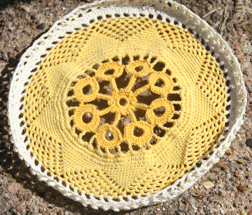
I hit a snag with the doily I was making for our Ravelry Irish Crochet Lovers crochet along. The last round of the doily pulled it up into a shallow bowl shape.
A simple truth of crocheting is that if it doesn’t lie flat as you’re making it, it will give you trouble for ever after. You can starch, you can press, you can think pure thoughts, you can hope that the next round will compensate and pull it flat, but the bowl-shaped doily will be true to its nature. In other words, not flat.
So I’m going to pull out that last round and redo it. Then it will be time to start adding the motifs.

And now, on to doily wonderfulness, as promised in the title of this post!
Irish Crochet Lovers of North America, listen up!
Maire Treanor, the author of Clones Lace: The Story and Patterns of an Irish Crochet, will be teaching two Irish Crochet classes at the annual Knit and Crochet Show and educational event in Manchester, New Hampshire, July 7-10, 2010.
The titles are: “Beginners Clones Lace” and “Be Creative with Clones Lace.” Find them under 6-hour classes at the link above. The class sample of the first class is a small doily.
If you want to learn about Irish Crochet Lace from a modern-day Irish Crochet master, this is your chance. She will also be teaching at Lacis in California, and in Minnesota. I’ll try to find details of these other workshops and share them.
Maire’s book is available from Country Yarns (once you get there, scroll down a little).
Suzann at the Knit and Crochet Show
I’ll be teaching at the Crochet Guild of America’s Professional Development Day, Wednesday, July 7, 2010, 8:30 AM – 5:00 PM It is part of the Knit and Crochet Show held every year in Manchester, New Hampshire.
Professional Development Day includes panels of experts who talk about how to make money with crochet, lectures by successful crochet designers, and lots of information on how to profit by your passion for crochet.
I’m part of the afternoon program, where participants have a choice of three different, hour-long, round-table sessions.
My session is entitled “A Book’s Journey – from Idea to Book Signings.” Here’s the description:
You have a great crochet book idea, but where do you start–and end? How do you identify potential publishers? How do you pitch your idea? What basic points should you look for in a contract? How do royalties work? How can you organize your time to meet deadlines? What happens after you submit the final manuscript and projects? What should you do while you wait for your book to appear on the market? Once your book is out, how can you increase your book sales? Learn the answers to these questions and more in this whirlwind lecture.
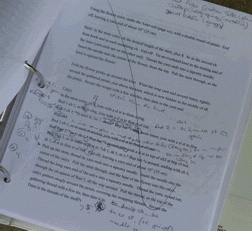
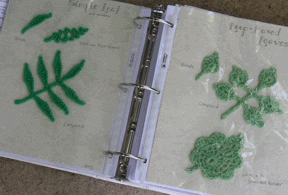
When Crochet Bouquet was finally finished, I gathered most of my notes, sketches, inspirational materials, and some correspondence between me and my editor, and put them into a big ring binder. I bring it along to talks like the one I’m giving at Professional Development Day.
Here are some sneak peeks into the notebook: some leaves from the original proposal; a draft of the Thistle pattern; a couple of party invitations that inspired me.
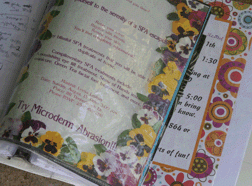
It’s a wonder how much writing, how many corrections, how many random bits of inspiration, and how much communication goes into a slim volume like Crochet Bouquet.
For more information about the CGOA Professional Development Day and registration information, please visit the Knit and Crochet Show site. Hope to see you there!
Power, Flower

It’s been a long time since I used the “Earthen House” (formerly “House Building”) category on a post. Our new house was delayed for one reason and then another since about 2006. But now we are back on track. Hurray!
The power company came out a couple of weeks ago and installed poles and power lines to our place. The poles make our driveway look more real, somehow–like an actual road. It’s an amazing shift in perspective, and a tangible indication of progress.
“Look at the copper ground wires glistening in the setting sun,” I said dreamily, as we walk down the driveway one evening.
My daughter laughed. “Mom, you’re the only person I know who would get so excited about electrical poles.”
Power to us!
And now the flower. Unbeknownst to me, after enlarging a roadside trench to keep rainwater from overflowing into our yard and under our house, Charles planted “North Texas Wildflower Mix” in the disturbed earth.
What a surprise it was this spring to find poppies, cornflowers, scarlet flax, baby blue eyes, and sandwort growing along the ditch. We love the red poppies, but this pink and white poppy was our favorite. It makes me want to copy it in crochet!

Shawl? Or Not?

I was excited to see monk’s cloth in Walmart! It’s like the cloth that cross-stitchers use, with a very regular, square weave that is easy to see and easy to stitch into. “I can crochet right into the edge!” I said.
So I planned a square cloth shawl with a crocheted floral trim. I made the flowery bits, which would be joined as I crocheted along.
Luckily I thought to wash the cloth first. It shrank quite a bit. It also fluffed up a little, and a flaw that I found after getting the fabric home resolved itself and I can’t even see it now.
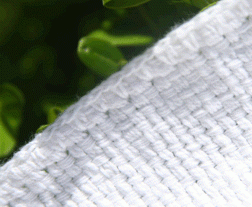
The decorative stitching added some interest to the stark whiteness of the cloth. And also, it was fun! I love decorative stitches, and it’s a good thing, because it took a long time to stitch across each side.
After zig-zag stitching around the cut edges, I folded the edges under and crocheted (*sc, sk 1 space in the fabric, ch 1*, repeat bet *s) all around the square.
Before starting the floral trim, I tried it on.
Oh no.
It looked like I was wearing a tablecloth.
I folded it this way. No joy. I folded it another way. Still no good. I squinted my eyes just so. Nope. I put it away for a day or two.
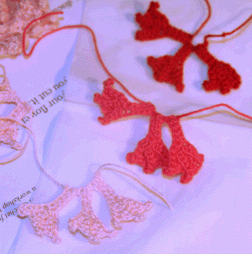
That did not help. It still looked like a tablecloth, and there’s nothing sillier than a plump, stern-looking, middle-aged lady wearing a tablecloth. Even if it has a pretty crocheted trim.
Well, now we have a new tablecloth.
But what about my shawl? I found some pretty fabric to match the flowery pieces I already crocheted. It’s not the kind of fabric you can easily crochet into, but I figured out a solution to that problem, and will report on it later.
Spiral Bind Your Copy of Crochet Bouquet
Curmudgea wrote a complimentary, heart-warming (my heart, for sure!) review of Crochet Bouquet. She brought up a subject that will have many of you nodding in agreement:
If I had one quibble, it would be that I wish the book were spiral bound so that it would lie flat on my lap when I’m working.

It makes good sense for craft books to be spiral bound. I imagine that the cost of spiral binding keeps many publishers from choosing that option. Also, when a book is on a shelf in a bookstore, the publisher really wants you to be able to read the spine–impossible with a spiral.
But never fear! Your local printing and binding shop comes to the rescue!
I took a copy of Crochet Bouquet to Staples Office Supply in Stephenville, Texas. Jessica, a helpful and friendly associate in the printing department, carefully shaved off the spine of the book. She adjusted the hole-puncher so the holes would be centered down the page.
We decided on a navy blue spiral, because the black spiral contrasted too harshly. Jessica inserted the spiral, trimmed and crimped it, and voila! Crochet Bouquet was spiral bound!
After cutting the binding away, the cover was still stuck to the first page. We left it that way. A 12mm spiral works best for Crochet Bouquet. If you like to write notes in your books, consider inserting blank sheets of paper before binding. You’ll have to trim them to size, and you may need a larger spiral.
The cost was $3.49 plus tax. If only all our problems could be solved so inexpensively!

Crochet Bouquet is Digital!

About a month ago, Amanda Carestio of Lark Books wrote to me with exciting news. Crochet Bouquet is now available as a digital book!
“We know that the knitting and crochet community has a large presence online,” Amanda said, later adding, “We’re doing our best to anticipate the market and to provide what crafters want in the format they want it.”
You can buy an e-copy of Crochet Bouquet at Zinio.com. Here’s the link.
When you buy a book from Zinio, you download the Zinio reader program, which is like a pdf, only more secure. The e-book pages look just like the paper book pages, with photos and illustrations.
At the moment, Amanda told me, digital readers like Kindle or the Nook do not support photography or illustrations. So for now, you’ll need to crochet at your computer. It’s a great solution for readers who like their craft books to lie flat. The computer screen is the next best thing to spiral binding!
And it looks like Crochet Bouquet is in good company. The March 17, 2010 issue of The New York Times said that best-selling author John Grisham has finally allowed his books to be issued as e-books. Before now, he was concerned about “piracy, pricing and the effect of digital editions on physical bookstores.” (“Arts, Briefly,” compiled by Dave Itzkoff, piece contributed by Motoko Rich)
I can’t comment intelligently about piracy, but the suggested retail price of the e-version Crochet Bouquet is the same as the paper version. Also, I think physical bookstores will be around for a long time yet. They’ve survived the onslaught of audio books and online discount bookstores, so they’ll most likely adapt and survive the e-book trend, too.
To my mind, the more ways a book can be available to readers, the better!
Ferns in February

Please join us in making a Fern leaf for February’s Crochet-Along!
Readers have adopted the Fern leaf (on pages 110-111) as one of their favorite patterns in Crochet Bouquet. (The other favorite is the Plain Pansy.)
The Fern is one of my favorites, too. Once you figure out how it works, the Fern is fairly easy to make. You can add leaflets or picots to alter its size and shape, as I did for this Christmas Tree Mat.

The Fern is a bunch of crocheted bumps or picots, separated by chain stitches or slip stitches. You begin at the base of the leaf, then
Following the pattern, work a series of chains and picots. When you have three picots right next to each other, you’ll know you are at the tip of the first leaflet (see inside the black box in Photo 1).

Work back along the chain you just made, slip stitching in each chain st, and making a picot across from each previous picot. Don’t sl st all the way to the end, because that’s part of the main stem. (Photo 2)

Continue making leaflets in this way. The fourth leaflet is one picot pair shorter than the first three. Now you have essentially worked “up” one side of the fern, as in Photo 3..

The top of the fern is three very short leaflets all clustered together as you see inside the pink box in Photo 4.

For the second half of the fern, you crochet the leaflets as you did before, but instead of chaining between the leaflets, you slip stitch down the center stem. (Photo 5)
When you’re done, you will have worked down the other side, and ended back at the base of the leaf.
There are many ways to make a picot (pronounce it PEEKoh). For our Fern, make a picot like this: ch 3, sl st into the third chain from the hook. When the pattern says “ch 3, sl st picot” that means you “chain 3, chain 3, slip stitch into third chain from hook.”
The pattern has lots of information to help you figure out where you are on the leaf. However, if you find this information distracting, copy out the instructions on a piece of paper, leaving out the extra words. See this post for a more details on copying out patterns.


