
Clones Knots with Máire

Irish crochet lace has been an inspiration to me since the 1980s, and so you might imagine how pleased I was to take an Irish crochet workshop from Máire Treanor at the Knit and Crochet Show earlier this month.
Máire is from Ireland, and she’s the author of Clones Lace: The Story and Patterns of an Irish Crochet.
Máire showed us some stunningly beautiful examples of crocheted lace from Clones. She said that the crocheters of old specialized in certain motifs. Someone else would buy a bunch of motifs and then crochet them together. She also showed crocheted laces from other countries, which were most likely inspired by Irish crochet lace.
See all the Clones knots in my class sample? They’re so cute! My favorite tip we learned was how to make the Clones knot by swiveling our crochet hooks back and forth.
My doily is about 12 inches (30 cm) across. Máire’s little crocheted doilies use even more motifs than mine, but hers measure no more than 5-1/2 inches (12 cm) across. She uses much finer thread.

When I’m finished joining all the motifs, I’ll take out the green tacking thread and remove the paper.
Several people asked me what yarn I was using, because they loved the pale pink and pretty butter cream colors. Aunt Lydia’s No. 10 crochet cotton. Really. The green shamrocks are DMC Cebelia No. 10.

Instructions for the motifs and the Clones knot appear in Máire’s book, which has been reissued recently by Lacis. The cover is slightly different than the one shown above. The catalog number is LH52, price US$28.00.
- Say Máire’s name more-or-less like this: MY-ra TRENN-r
- Clones is pronounced CLOH-ness. It’s the name of a town in Ireland.
Crochet in Manchester

My first impressions of Manchester, New Hampshire, earlier this month were: the wonderful smell of pine mulch, red brick buildings, street names that reminded me of American History class, and pretty little red peppers growing into the fences along the sidewalk. Oh, and an unusually large number of ladies wearing crocheted clothing.
The Knit and Crochet Show was in town! It started on Wednesday morning with the Crochet Guild of America Professional Development Day. I enjoyed listening to Kristen Ohmdahl and Lily Chin speak about their lives and careers as authors and teachers.

The same afternoon, I went to work, conducting three consecutive round-table discussions of “A Book’s Journey, from Idea to Book-Signings.” Our table was full and overflowing for all three sessions, so I’m expecting to see a bunch of new authors publishing their crochet books in the next couple of years.
When they could get a word in edgewise, people asked great questions. I was pleased to note a healthy interest in publicity. Nowadays it’s very, very important that authors be involved in the publicity for their own books.
But it wasn’t all work for me. The next day I took a class for the first time in ages. Yay! Here’s my class sample. I wrote more about the workshop and my teacher, Máire Treanor, at Clones Knots with Máire.

The convention hotel was in downtown Manchester, so we could walk to all kinds of shops and restaurants. My favorite was Lala’s Hungarian pastry shop and cafe. Their most unusual item was sour cherry soup, which was cherries in a sweet-tart yogurty sauce, served cold. The stuffed kohlrabi leaves in dill sauce were mouth-wateringly good. I’ll go back just for the pastry and coffee.
I hope the Knit and Crochet Show will be in Manchester again someday.
During, Before, and After the Rain

We had a good rain yesterday afternoon. A power line broke during the storm, which left us without power for about three hours.
Eva was crocheting a gift for a friend who is moving away. She did not let a little power outage stop her work. Here she is, crocheting by flashlight.
Luckily, our slab was poured the day before! The weather has been so hot, the contractor spread hay all over the fresh concrete, and we have to water it a couple of times a day. The rain watered it yesterday!

Those heavy stem walls you see in the picture are going to support compressed earthen blocks which we will make with a totally fabulous machine manufactured by AECT of San Antonio, Texas.

We had to have a concrete pump for this last concrete pour. That pump was a thing of beauty. Mr. Hammer, the owner and operator, used a remote control device to move the pump around. When he raised it up over the trees and moved it over our slab, it looked like a slow and graceful mechanical ballet dance. Gorgeous! In this picture, the concrete truck is dumping concrete into the pump.

This prickly pear cactus, which grows on our new place, is the native home of the cochineal beetle. The rain made the bugs’ webby homes a little soggy. Usually they are pure white, but the wetness has made the beautiful bluish red show through. You can probably see the color better in the close up, below.
Cochineal revolutionized the dyeing industry in Europe a few hundred years ago. The tiny beetles made the best red dye ever, until chemical dyes came along.

Ladybug and Heating Pipes

Knitters, always remember that duplicate stitch is an alternative for adding small areas of color to your projects! Also, you can use duplicate stitch to customize store-bought sweaters.
Essentially, you thread a needle with your yarn and embroider over the knit stitches that are already there, duplicating their shape as you go.
I designed and embroidered this ladybug on a purchased cardigan many years ago. Both my girls have outgrown it now. Before putting it away, I wanted to show it off. I used embroidery floss to do the duplicate stitch. It thickens the fabric a little, so I prefer to use it fairly sparingly.
This pattern was published under the title “Ladybug, Fly Away Home!” in Wearable Crafts (Vol. 3, No. 4, p. 31, August 1993).

Here’s looping of a different kind. These are pipes for our under-floor heating system. The pipes run into and out of a manifold that is attached to a pump and eventually to its own water heater. So we’ll have warm feet in winter. Yay!
First my Dad, Eva, and I laid in the insulation boards and duct-taped them all. Then my brother Van and I installed the pipes. He studied the instructions very carefully so our installation went smoothly. The people at Radiantec (where we bought the system) are very helpful and patient with their do-it-yourself customers.
In a few days all this will be covered by concrete, and we’ll be ready for the roof.
Palm Leaf CAL and Tutorial

School is nearly over for the two daughters in my house, and they’ve already asked if we can spend some time at the beach this summer. This reminded me of palm trees, and that reminded me of the crocheted Palm Leaf on pages 112-113 of Crochet Bouquet.
Please join me in crocheting the Palm Leaf for our June 2010 Crochet Along. To help you figure it out, here is a tutorial.

Row 1 is easy enough, and you can see Row 1 completed in Photo 1.
Originally, I wrote this pattern with three rows, but my technical editor, kjhay, felt it would be easier to understand if we combined my rows 2 and 3 into a single instruction, which is Row 2 in Crochet Bouquet.
Row 2 of the Palm Leaf pattern begins at the center of the leaf, goes out to the tip of a spike, and back to the center.

Photo 2 shows the Palm Leaf after “ch 11…” on the very last line of page 112. The ch 11 is a long, long turning chain.
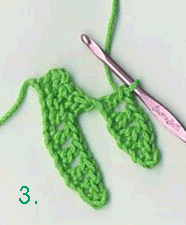
Now turn and work back along the chain. Photo 3 shows what the piece should look like after the “3 times;” on the second line of page 113.
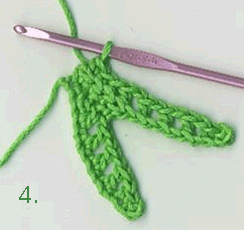
The next few stitches are actually worked into the first few stitches of Row 2, bringing us back to the center of the leaf (Photo 4).
The instructions tell you to make the stitches into the back loop only. Most of the time, we catch the top two loops of any crochet stitch as we work. The front loop is the one that is closest to you as you work. The back loop is the one that is away from you as you work.
Working into the back loop each row, as we’re doing in the Palm Leaf gives a corrugated look, and it helps us gather the leaf when we’re finished crocheting the points of the palm.
Repeat Row 2 seven more times, and end with a piece that looks like the one in Photo 5.


To gather the leaf, pull up a loop in the base of each spike, except the one you just finished. It doesn’t matter where you put your hook, as long as there’s one loop for each spike. (Photo 6)

Yarn over hook and draw through all the loops on the hook. Pull the loop tight to close the gathered edge as much as possible. (Photo 7). Ch 1 to anchor the gather. Then make the stem.
Now that you can make the Palm Leaf, check out Topsy Turvy #1 (pages 40-41 of Crochet Bouquet). It works exactly the same way.
Powerful Pearls
Like most blog writers, I’m eager to know when others link to my site. Recently I found a link coming from a foreign language site. I peered closer at the link. It was Turkish, and, and, AND…I could read it!

How does a gal from Texas decide to study Turkish? And what in the world does this have to do with Crochet Bouquet?
Well, I’ll tell you.
We must go back twenty five years or so, to the Austin Public Library, where I found this book: Tulips, Arabesques, and Turbans: Decorative Arts from the Ottoman Empire (by various authors, Abbeville Press, New York, 1982). This book introduced me to the wonderful ceramics, metal work, textiles, and calligraphy of Turkey.
A motif you’ll see frequently in Turkish tiles and textiles is chintamani, or the three dots. They’re often used together with wavy lines. The three dots probably represented three legendary pearls floating on the waves of the sea. The pearls symbolized good luck and power.

The three dots motif was the inspiration for the Pearl Trillium, on pages 87-88 of Crochet Bouquet. The sea waves became the wavy leaves behind the flower. You probably noticed that the colors I chose for the flower are from the cover of the book.
As I pored over the gorgeous images in Tulips, Arabesques, and Turbans, I vowed I would go to Turkey someday and see those wonders for myself. That’s why I’m learning Turkish.
Many thanks to farfin for linking to Curious and Crafty Readers.* To return the favor, here’s her site, 10marifet.org, which has lots of cute craft ideas and great examples of needlework. You don’t have to read Turkish to enjoy. Çok güzel! Teşekkür ederım, farfın!
* Curious and Crafty Readers was originally meant for blogging about my books, but now all those posts have been folded into textilefusion.com/blog.
Dotty House and Weld Plates

Here’s a little coaster knitted in the mosaic technique, which I prefer to call Dotty Knitting. The whole thing is about 4 x 4.5 inches. It needs blocking, but I couldn’t wait to share it, because it’s so cute!
Once you know how, it’s pretty easy to chart a picture or fancy motif in the mosaic knitting style. And then away you go, knitting a house. If only building a house were as easy, I’m sure I could have knitted several good-sized houses by now.

Speaking of houses, here is a weld plate. My foot is in the picture to give you an idea of scale. It is a big, burly weld plate. Weld plates are embedded in the foundation of a building. Our house will have a metal roof, supported by pipes which will be welded to these weld plates.
The original weld plates were too wimpy, according to my cousin Jerry, who is advising us as we build the house. The mere sight of my foot would have sent them scuttling away in fright, on their too-short and skinny little hooks. Only they didn’t even have real hooks, but l-shaped rods instead. Pah. We showed them.

While heavy machinery and beefy weld plates dominate one part of our lot, this interesting flower is growing on another. It’s a milkweed called Antelope Horns.
Who loves to eat milkweed? Monarch butterflies! I hope some monarch momma will lay her eggs on our Antelope Horns someday.
Happy Mother’s Day from Crochet Bouquet!

Here’s a bouquet of one of our lovely Texas wildflowers, the Firewheel, for all Mothers! Especially mine!
The Firewheel is also known as Indian Blanket and Gaillardia. We love Firewheels at our house.
I considered naming one of our children after this flower. But that wasn’t to be, so we named our dog Firewheel. It suits him!
Find instructions for a crocheted Firewheel on pages 83-84 of Crochet Bouquet. Here is a correction for that pattern:
Fire Wheel, page 84, add a “(” (shown in bold below) before the word “insert”
Rnd 2: *Ch 7, (sl st-picot) 4 times; yarn over (2 loops on hook), skip next picot, (insert…

Bu örgü Teksas’ta çiçek var, adı “Fırewheel.” Türkçe’de “ateş tekerlekin.”
Eine gehäkelte texanische Blume, “Firewheel” genannt; auf Deutsch, “Feuer Rad.” (Ist das richtig, meine liebe Mutti?)
Crochet a Mother’s Day Card

You still have time to give your mother a hand-made card for Mother’s Day!
Page 129 of Crochet Bouquet gives general directions for making greeting cards with crocheted flowers.
Mostly you need to choose a flat flower or leaf, and use a fine thread to make it. Find blank cards and matching envelopes at craft stores.
For the card shown here, I used
- Aunt Lydia’s No. 10 crochet cotton in violet, golden yellow, shaded violets, wasabi green
- size 4 (US) steel crochet hook
- blank card and envelope (I bought extra in case of mistakes)
- rubber stamp with “Thank You” or other message that you like
-
stamp pad with gold ink
- Practice stamping on some scratch paper until you get the feel of the stamp and ink. When you’re confident, stamp the blank card.
- Crochet the Plain Pansy (pp. 63-64 of Crochet Bouquet) and the Spiky Leaf (pp. 121-122). Make a chain the desired length for a stem, turn, skip one ch st, slip stitch in each stitch of the chain.
- Weave in the thread ends and press flower and leaf if necessary.
- Arrange flower, stem, and leaf on card. When you are pleased with the arrangement, glue them to the card, following the directions on page 129.
Doily Woes and Doily Wonderfulness
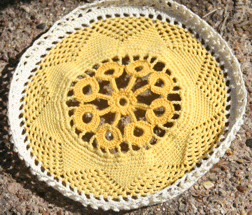
I hit a snag with the doily I was making for our Ravelry Irish Crochet Lovers crochet along. The last round of the doily pulled it up into a shallow bowl shape.
A simple truth of crocheting is that if it doesn’t lie flat as you’re making it, it will give you trouble for ever after. You can starch, you can press, you can think pure thoughts, you can hope that the next round will compensate and pull it flat, but the bowl-shaped doily will be true to its nature. In other words, not flat.
So I’m going to pull out that last round and redo it. Then it will be time to start adding the motifs.
And now, on to doily wonderfulness, as promised in the title of this post!
Irish Crochet Lovers of North America, listen up!
Maire Treanor, the author of Clones Lace: The Story and Patterns of an Irish Crochet, will be teaching two Irish Crochet classes at the annual Knit and Crochet Show and educational event in Manchester, New Hampshire, July 7-10, 2010.
The titles are: “Beginners Clones Lace” and “Be Creative with Clones Lace.” Find them under 6-hour classes at the link above. The class sample of the first class is a small doily.
If you want to learn about Irish Crochet Lace from a modern-day Irish Crochet master, this is your chance. She will also be teaching at Lacis in California, and in Minnesota. I’ll try to find details of these other workshops and share them.
Maire’s book is available from Country Yarns (once you get there, scroll down a little).