
Crochet Garden at TNNA, Columbus, Ohio

Imagine a market where yarn shop owners go to buy stock for their stores. It’s like the best dream ever! That’s what’s in store at The National Needlework Association Summer NeedleArts Trade Show in Columbus, Ohio, June 23-25, 2012.
The show is open to TNNA members, like yarn and needlework shop owners, manufacturers, publishers, designers, and teachers. In other words, people in the business of yarn- and needle-crafting.

I’m going to be there, signing copies of Crochet Garden at the Dale of Norway Yarns booth (booth numbers 510 and 512). I am so excited!
Kathryn, a knitting guild friend from way back in our Austin days, introduced me to Dale of Norway Yarns years ago. I fell in love with the deliciously bright colors of Heilo and Baby Ull. As a color-lover, I was impressed that a person could buy yarn in so many different qualities of one color. The patterns were gorgeous, too. The knitted baby clothes were just darling.
The bright colors of Dale of Norway Falk were perfect for these Trilliums (pages 126-127 of Crochet Garden).

The Summer NeedleArts Trade Show is for TNNA members, but if you can’t go as a member of TNNA, please encourage your local yarn shop owners to drop by and say hello.
If you are a needlearts professional, and you haven’t joined TNNA, visit the TNNA website for more information about this helpful.
Tallahassee Has Yarn!
In the days of my youth, I heard actual people say in all seriousness, “It’s too hot in Texas to knit.” It’s true—the fact that they said that, I mean.
I didn’t understand at the time how it could be too hot to knit. Now, at a much advanced age, I still don’t understand!

One might assume it was too hot and humid to knit in Florida as well, but the knitters of Tallahassee obviously don’t think so, because Tallahassee supports three yarn shops!

Charles and I visited the lovely, green, tree-ful city of Tallahassee in May, when the white crape myrtles and jasmine were in bloom. While he attended an archeology conference, I went yarn shop hopping.

Yarn Therapy was my first stop, where Marianne (she’s in the photo) gave me a quick tour of her great sock yarns. She has several brands, including some that are custom-dyed for the shop. I had to buy Pagewood Farm Denali Hand Dyed Sock Yarn in the Watermelon colorway for some socks for myself. I love those colors together.

I managed to slip in a mention of my crochet books. Marianne and Heather wanted to see them, and I happened (!) to have some copies in the car. We took pictures, and they posted the photos on the internet right away. Technology can be so much fun.

After a delicious Thai lunch, I went to the Railroad District for more yarn shopping at Really Knit Stuff. Paula gave me a big Texas greeting when I walked in. She’s from Texas, but hasn’t lived there in a while. I can’t blame her for choosing Tallahassee. I loved her hairstyle, which was a long braid with yarn as one third of the braid.
She stocked Classic Elite Yarns Liberty Wool, a long-repeat variegated yarn. She cleverly provided knitted-up samples, so customers could see the range of colors in a skein. I left with some Liberty Wool to make a flower-cloth scarf of Russian Picot Daisies (from Crochet Garden). Here’s the beginning of it.


The Railroad District has quirky and colorful shops and workshops, including the flower building above. Outside the bookstore there, I saw evidence of Tallahassee’s hospitality for dogs. Our hotel had a similar spread.
Tallahassee looks small from the air, because the many trees hide the buildings. It’s a good place. I would visit again.
Mexican Hat Step by Step

The roadsides around our house are abloom with Mexican Hats, aka Hat Flowers, so it seems a good time to do a Mexican Hat Step by Step.
The pattern is on pages 24-26 of Crochet Garden. You choose whether to make one or two rounds of petals. For this tutorial, I made the double flower. The photos are to supplement the crochet instructions in the book.

Both flowers start with the tall center, a tube of single crochet worked round and round through Rnd 7. Be sure that you’re inserting your hook from the outside of the tube.
In Rnd 8, you make ch-3 loops around and then stuff the tube. Now it looks like Photo 1.

You close off the tube with Rnd 9, cut threads, and weave them in.
Rnd 10 starts the first round of petals in the ch-3 loops you made in Rnd 8. In Photo 2, you can see burgundy centers of four petals created in Rnd 10, along with the first part of Rnd 11 (yellow thread).
To give the petals their characteristic shape, their edges are pinched together with stitches. Rnd 12 pinches each petal and it creates ch-3 lps as the foundation for the next round of petals. You are still working in the same direction, but you have to look on the underside of the flower to insert the hook.

Photo 3 shows a completed Rnd 12 from the underside of the flower. Each petal has a sl st at one side of its base, a ch 1, then another sl st on the other side of its base. This is what pinches the petal into shape. Between the petals you’ll see the ch-3 lp that forms the base for the next round of petals.
Since I was going to use the burgundy and yellow threads again for the second round of petals, I fastened them off but I didn’t cut them.

In Photo 4 you can see the first petal of Rnd 13 peeking from between two petals. When Rnd 13 is done, the underside looks like Photo 5.

Rnd 14 completes the petals.

In the sepal round (Rnd 12 of the single flower, Rnd 15 of the double flower), you are once again pinching the petals together and at the same time, you’re creating the green sepals, as in Photo 6. The sepals are little green spikes that curl out from between the petals.
I’m hoping my daughter will make some tutorial videos for me this summer. The Mexican Hat seems like a good candidate for a how-to video. What do you think?
Errata for Crochet Garden

The yellow flower at the lower right edge of the cover is the Pasque Flower. The purple and yellow version is on the copyright page, and a couple of tiny Pasque Flowers are on the back cover. It’s shown at the top left of page 11, with the alternate center of eyelash yarn.
It’s such a cute flower. Somehow, we cut the instructions for the Pasque Flower but left the flower on the cover. Arghh! But never fear–click here for free instructions for the Pasque Flower.
Iris, page 28
Last line of Rnd 4, add “Join with sl st to first st of rnd” as shown in bold below.
-
from * twice. Join with sl st to first st of rnd. Fasten off B if desired. Turn.
European Rose, page 81
Under Materials & Tools: 4 colors of yarn of similar weight: center color (A), greenery color (B), one or two petals colors (C and D); no stuffing required.
Twirl Center Rose, page 117
PM means ‘place marker.’
Third line of Row 1, delete “PM in the 4th hdc,†so that the line reads as below.
-
3 ch, (3 dc) in each of
Poinsettia, page 92
Rnd 3, First petal and Second petal: when you are working up the side of the petal, after the 2 sc in the ch-2 sp, you will be working in the free loops of the chain. See http://www.textilefusion.com/bookblog/?p=1031 for a photo that will help you see where to put the stitches.
Rnd 5, all petals, same as above.
* * *
If you find a mistake in the instructions or if you have questions or comments, please let me know. Here are three ways to contact me:
- Leave a comment on my blog: http://www.textilefusion.com/bookblog
- Send me a message on Ravelry. My tag is “textilefusion.â€
- Email me: knitandcrochetwithsuzann at outlook dot com.
Thank you!
Suzann Thompson
Author of Crochet Garden
* * *
Leaves and Berries Spray, Free Crochet Pattern

Here’s a design inspired by blue and white Zwiebelmuster chinaware. You can crochet the berries, or use buttons for berries.
Materials and Tools
2 colors of yarn of similar weight: dark and light leaf colors (A and B), berry color (C)
Hook: Appropriate size hook to achieve a firm gauge with selected yarn
Tapestry needle
Special Abbreviations
Join-dc: find the dc on the previous leaf that is opposite of the dc you are about to make. In this pattern the dcs that you will join to are shown in brackets [ ] to help you identify them. With the yarn in front of the hook, insert hook into the back loop of the dc. With this new loop on the hook, yoh (yarn over hook), insert hook into next st, pull up a lp, yoh, pull through 2 lps, yoh, pull through 3 lps—join-dc is complete.
Essentially, you started with an extra loop on your hook before you made a dc. The last yoh was pulled through 3 lps, instead of the normal 2 lps.
Pattern Note:
After making this pattern once or twice, you will understand how it works, and you can repeat more or fewer times between *s to make your leafy spray longer or shorter. Brackets [] are used as markers in this pattern. Ignore them until you get to the join-dcs.
Instructions
Leaf Spray:
Rnd 1: With A, (ch 9, sc in 4th ch from hook, 5 sc, ch 4 for stem) 3 times.
At the top of the spray, (ch 9, sc in 4th ch from hook, 5 sc) 3 times.
Working down the opposite side of the spray, (sl st in each of the 4 stem ch-sts, ch 9, sc in 4th ch from hook, 5 sc) 3 times.
For lower stem, ch 12, sl st in 3rd ch from hook, sl st in each rem ch-st, cut thread and needle-join to the free loop of the 1st ch-st of rnd (it is at the base of the 1st leaf). Weave in ends.
Rnd 2: Join B in 1st ch-st of Rnd 1 (at the base of the 1st leaf) with a
* sl st, working along the free loops of the original ch-sts, sc, hdc, 3 dc, (3 dc, slst-picot, 3 dc) in the ch-3 lp; continuing along the tops of the sc-sts, [3 dc], hdc, sc, sl st.
(Sl st in ea of the 4 ch-sts of stem, sl st in 1st st of next leaf, sc, hdc, 3 join-dc, (3 dc, slst-picot, 3 dc), [3 dc], hdc, sc, sl st.) 3 times. *
The top leaf is not attached to the previous leaf: sl st, sc, hdc, 3 dc, (3 dc, slst-picot, 3 dc), 3 dc, hdc, sc, sl st.
Repeat bet the *s once more.
Stem: Sl st in each ch to the end of the stem, and then sl st in each sl st back up the stem, cut thread and needle-join to 1st st of rnd.
Berries:
Make one for each leaf pair.
With C, ch 4, join with a sl st in 1st ch to form a ring.
Rnd 1: ch 1, 8 sc into ring, leaving enough yarn to sew the berry onto the spray, cut yarn, and needle-join to 1st st of rnd.
Finishing:
Weave in all ends except the sewing ends. Sew a berry (or button) at each intersection of the stem and a leaf pair. Weave in sewing ends. Block.

Interweave Knitting Lab

When someone mentions the name “Interweave,” I think of fine publications about fiber and textiles. It’s a prestigious name!
So you can imagine how very excited I am to be teaching for Interweave Knitting Lab New England, October 4-7, 2012, in Manchester, NH!

My classes are
- Color, Texture, and Structure with the Elusive Slip Stitch (all day, October 4)
- Color Composure (all day, October 5)
- Knit Mosaic Patterns and Chart Your Own (morning, October 6)
- Seamless Argyles in the Round (afternoon, October 6)
And a lecture:
- TextileFusion: A Knitting of Art (evening, October 4)
I hope to see you there!
How is Crochet Garden Different from Crochet Bouquet?

Beth, a friend from Ravelry, sent me this message, and it was a great opportunity to get on my soapbox. Thank you, Beth! The soapbox is one of my favorite places!
Was wondering – about your Crochet Garden book, are there lots of new patterns in your new book, please? How would you describe the book in relation to its predecessor?
All the very best
Beth
Hi Beth!
Crochet Garden has all new flower patterns. I’d say it is very focused on its four themes:
-
Botanical Garden (realistic flowers)
-
International Garden (flowers with a tie to various countries around the world)
-
Inspired Garden (flowers interpreted from decorative arts like embroidery, weaving, chinaware)
-
Fun and Fantastic Garden (imagine “Candy Cornflower,” “Imp Flower,” and “Frost Flower”)
It also has a few leaves, a peacock, a butterfly with variations.
Crochet Garden reintroduces a vintage crochet stitch, the Russian Spoke Stitch. The Tole Tulip (shown above) and the Twirl Center Rose are noteworthy for their unusual and cool construction.
Thanks for asking!
Suzann
European Rose Featured at Lion Brand

Lion Brand Yarn Company provides the pattern for our May 2012 Crochet Along! The European Rose from Crochet Garden is featured at Lion Brand’s website, with free instructions, step-by-step photos, and some hints for easier crocheting.
The white Yorkshire Rose was my original inspiration for this flower, but by changing the petal colors, you can also make a Lancashire Rose (all red petals) or a Tudor Rose (white petals inside, red petals outside). When my mom saw this design, she said, “Oh, it’s a Martin Luther’s Rose!”
Then I saw it in a book, under the name “Alchemical Rose.”
It’s a rose by many other names.
Russian Picot Daisy Step by Step

Alternating treble crochet and single crochet gives the Russian Picot Daisy’s center its bumpy surface. Crocheting a trc immediately after a sc can be a little awkward, but you’ll soon get used to it. Try to bend each trc toward the front of the work as you begin the next sc. If some trcs bend toward the back, just push them out toward the front with your finger.

The petal round is where the fun begins. We make the vintage Russian Spoke Stitch that I described in my last post, and we turn it into a picot or shell-shaped petal.

It’s been over a year since I designed this flower for Crochet Garden. Since then I figured out a way to make the stitch a little easier. After you ch 7, insert a safety pin into the last ch st, which is on your hook (see Photo 2). You’ll come back to this later.

Working along the chain, * insert your hook underneath the chain, yarn over, and pull up a loop as in Photo 3.

Yarn over again and pull the yarn through one loop only, as you see in Photo 4. * For this particular flower, repeat between the *s 13 more times.

After you have sl stitched into the next st of the round below, you’ll have 16 loops on your hook: the ch st with the safety pin in it, 14 loops of the spoke stitch, and the sl st. (See Photo 5.)

Yarn over and draw the loop through all the loops on the hook. When you’re done, it will look like the tall double-bullion-like stitch in Photo 6, which is the complete Russian Spoke Stitch.
To continue to the picot, with your hook still in the loop, pull the yarn in the direction of the arrow you see in the photo. Pull until the tall stitch bends over double, creating a plump picot.
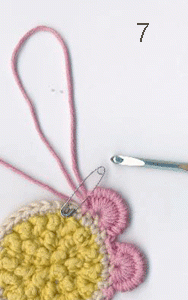
Secure the new picot with a sl st in the next st of the round below. Sl st again, then pull the yarn loop out as in Photo 7. Take your hook from the enlarged loop. Insert the hook into the loop with the safety pin in it. Remove the safety pin. Insert the hook into the enlarged loop and tighten the loop around the hook. Draw this loop through the loop that once had the safety pin in it.
You just finished a Russian Picot! To begin the next picot, sl st into the next st of the round below.
The Russian Picot requires 4 sts of the round below:
- Sl st into the round below, before you crochet the long chain.
- Sl st into the round below when you have finished covering the chain with loops.
- Sl st into the round below to secure the picot.
- Sl st into the round below before you stitch down the outer corner of the picot.
Russian Spoke Stitch Resurrected

The Russian Spoke Stitch and the Russian Spoke Picot were invented by a lady named Olivia Longacre Wertman to mimic the look of Russian darning. Here’s an example of Russian darning on a net tablecloth that my grandmother, Gertrud Wirth, embroidered a long time ago.
Mrs. Wertman’s instructions (with very good step-by-step photos, by the way) were published in 1900. You can read them free of charge on Google books–just search her name. Look under the title “Relief Crochet.”

When I first read about the Russian Spoke Stitch and the Picot, I thought, “This is so clever! Why haven’t I seen this before? Why hasn’t someone resurrected this stitch? Why isn’t anyone teaching about it? Why aren’t they publishing cool patterns with it?”
As these questions hung in the air, a revelation arrived, and stood there tapping its foot. “Hello-o-o-o-o,” it called. “Anybody home? Coo-ee! Suza-a-a-a-annnnnn, are you there?”

Oh! Wait a minute! I get it! Could the person who resurrects this stitch be…me? How about if I teach about it? Could the person who publishes cool patterns with this stitch be me as well?
“Um, yeah. Okay. Sure,” said the revelation, rolling its eyes. “About time.”
So, this is what we have so far:
- The Russian Spoke Flower in Crochet Garden: pages 100-101. It’s the pink flower above.
- The Russian Picot Daisy in Crochet Garden: pages 76-77 (the lavender and purple flower above). Both flower samples are crocheted with Cascade Yarns Cascade 220.
- An opportunity to learn how to do these stitches in my class “Full of Bullion (Stitch, That Is)”at the Knit & Crochet Show (Instructions for the crocheted insertion below are in the class hand-out.)
-
A how-to article and gorgeous capelet pattern in an upcoming issue of Crochet! magazine.
UPDATE: “The Double Bullion: A New Take on a Vintage Stitch,” Crochet! pp. 22 ff., Vol. 25, No. 3, Autumn 2012. Shoulder wrap pattern: “Purple Haze Shoulder Scarf,” Crochet! pp. 24 ff., Vol. 25, No. 3, Autumn 2012.
- And a Russian Picot Daisy Tutorial, soon on this blog.
Now I look forward to seeing what you do with these new/old stitches!
