Personal Red Cardigan Challenge

Ella is nearly two and a half years old. I started this cardigan before she was born. I want to finish it before next winter, so I joined KnitRedKAL to motivate myself to finish. All I have left to do is the sleeves and the button bands and other finishing. We’re visiting family this weekend, so we have to drive about 5-1/2 hours one way. I’m hoping to get a lot done on the drive.
After that I will knit three rows each day until this rascal is finished. At that rate, the whole thing should be finished about mid-September. Three rows a day doesn’t sound like much, but at least I should be able to handle it.

Here it is close up. It’s my famous 😉 Seveness Technique: Suzann’s Sensational Similar Shade Scrap Stripe System (seven S’s).
The KnitRedKAL is meant also to raise awareness of heart disease in women. Our family has a history of heart disease, so I appreciate the underlying motive.
All moral support appreciated!
Salt and Pepper Done

After weeks of sitting around my living room in a basket, waiting for its collar to be bound off and its sleeves to be sewn in, the Salt and Pepper Jacket is done!
We went out of town for the weekend to visit family, and I brought it along, thinking that surely I could find two hours to finish the job. Charles and his brother took Eva, Ella, and their cousins swimming. I stayed at the house with my sister-in-law and father-in-law. We talked and sipped coffee while I worked on the jacket. Very pleasant.
Now I have to write instructions and send the sweater to INKnitters for the Summer 2005 issue. I’m posting a preliminary sketch instead of a photo, because you will be able to see the real thing in the magazine in a few weeks. The jacket is for girls, ages 8 to 12 or so.
See posts on March 22 and April 4, 2005, for more on the Salt and Pepper Jacket.
Button Making Medley Workshop
My new buttons samples are finally done! The workshop is Friday afternoon, June 3, at Camp Iwannaknit 2005. There’s still room in the class!
We will make five styles of buttons: fake lapis buttons and color swirl buttons in polymer clay, felt buttons, and two different kinds of Create-A-Button. Here are my samples:


The faux lapis and color swirl buttons are easy to make from polymer clay, but they are very good looking. Color swirl buttons have converted many uncertain crafters to polymer clay enthusiasts.

These are made from dyed wool roving.

Create-A-Button is a product of Clover Needlecraft, Inc. The flower-style is a plastic dome with notches and three strategically-placed holes, which allow you to wrap it very evenly. Then you can weave between your wraps (like the coral button above) or even wrap the wraps as you would for a Dorset button (beige button).
The mesh-style Create-A-Button is a plastic dome with holes, which you can embroider through or sew beads, sequins, or other embellishments into. When you’re finished decorating the top, snap a fitted plastic disk to the bottom of the dome to complete the button. Unfortunately, these buttons have to be removed every time you wash the garment they are on.
Fire Ant Ranch

Last weekend we drove to Elgin, Texas, to visit my friend Suzanne Correira, owner of Fire Ant Ranch. She raises Black Welsh Mountain sheep, Gulf Coast Native sheep, and some Shetland sheep and Angora goats. She sells the wool, fiber packets ready for spinning, handspun and hand-dyed yarns, spinning tools, and more.
We hadn’t seen each other since 1996, just before my family left to live in England. It was good to catch up with each other, and to see the improvements Suzanne and her husband, Alfred, made on their land. Suzanne already knew our older daughter, but hadn’t met our two-year old.
Suzanne kindly let Eva and Ella feed her two Shetland bottle babies. We visited with her numerous cats. We walked down the hill and watched the ewes and lambs run out into the pasture. But it was unseasonably cold and rain threatened, so my husband lured the girls into the car with promises of going to Austin to see a movie. They love movies, and that is fine, because they don’t get to watch TV at home (we don’t have one).
Alfred brewed us some delicious coffee, which we sipped while talking about Suzanne’s business and the fiber business in general. I will write an article about Fire Ant Ranch for INKnitters magazine. Look for it in the fall.
Then I shopped. Suzanne is an Opal sock yarn dealer. Had to buy some of that. I couldn’t resist a green and yellow batt for spinning. One of my rules is: When you see a good green or yellow yarn, buy it. A batt is potential yarn, isn’t it?!

A Rock Pile called my name. It is a Fire Ant Ranch specialty consisting of ready-to-spin wool with locks of dyed mohair here and there. Mine is gray Shetland with foresty-green mohair.
Naturally, I must test spin some of Suzanne’s fibers before I write the article, so I bought some Black Welsh Mountain and Gulf Coast Native fleece. Now I have a good excuse to get my spinning wheel out of storage. I long to get spinning, but must stay focused on preparations for Camp Iwannaknit, my overdue INKnitters article, and another article in the works. Come June, I am going to spin.
Progress on Salt and Pepper
The Salt and Pepper Jacket is nearing its end! Hurray! I am ready to get it done so I can go on to other things. I restarted the collar several times Saturday night, trying to get it right. While I knitted, my daughter and I watched a 007 movie–Die Another Day.
It was educational. Really. We have a DVD of Jimmy Neutron in “Jet Fusion.” There are lots of James Bond references in the cartoon (if that is what you call computer generated animation). We had to watch a real James Bond movie so she could make the connections. We always go the extra mile to provide education to our children.
One good thing about writing for money is that it forces me to focus on a project until it is done. Otherwise I would go and start gobs of projects, and put them aside once the initial thrill was over.
Taos Festival Workshops Open

The Wool Festival at Taos takes place the first full weekend in October, and you can attend fabulous fiber and textile workshops before and after the Festival weekend. The workshop descriptions are up on the web site, and you can register now. UPDATE 2022: The workshop descriptions are no longer available.
Yes, I’m teaching there. Hurrah! My family is coming, too, because Charles can’t pass up any opportunity to go to Taos. My classes: Crochet Flowers, Alternative Tassels and Trims, Knit or Crochet an Underwater Scene (by hand this time), Small Quilts and Tote Bags from Old Sweaters.”
Design Workshop: Seaweed
I knitted seaweed and coral last night. Now I have a much better idea of what I will need to complete the sample. I will re-knit the bright green seaweed. It was supposed to look more like the dull green, but I made the center rib too wide and the other sts too narrow.
The orange pieces didn’t turn out the way I expected. The dull orange is too close to beige, so I’m going to look for another orange. Luckily, the knitting on these goes really fast. Just cast on 4 on the Ultimate Sweater Machine, hang a claw weight on the four sts, and knit for a few minutes. The narrow stockinette st band rolls in on itself for a faux i-cord. (Design workshop participants, here’s another opportunity to get a little ahead in the workshop!)

The holey piece is for squat, sponge-like objects. I knitted a piece with the top background colors so I could make some ‘pebbles’ and other raised elements. See the magenta rows in these two pieces? After I secure the sts on either side of the magenta, I will cut along the magenta row to separate pieces. This saves time casting on for each little piece of knitting.
When I make wall-hangings, I do just like this: knit or crochet a few of the embellishments, just to get going. Once I see how they look on the background, I have a much better idea how to proceed. I rarely get it right the first time.
On Sunday, I’ll post newly-knitted seaweeds, and other embellishments, and I hope to have started composing with the pieces I already made.
Lovely Artyarns
I knitted with Art Yarns’ luxury hand-painted Supermerino for the first time ever and I hope it won’t be the last. Wow. ‘Luxury’ sums up the feel of this smooth and soft yarn. And I love this color combination…

The sample is for my next INKnitters article. I spend a lot of time knitting samples. They’re great for taking outside to knit while I watch my two-year-old play, but I really want to get back to making wall-hangings and clothing for myself and my kids.
Design Workshop: Quilted and Bound
Here’s the sample from the last post, all stabilized, trimmed, quilted, and bound.
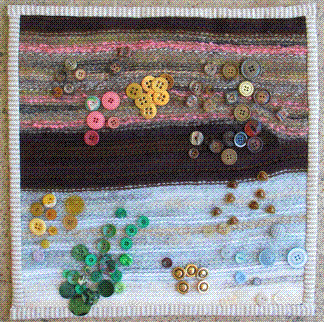
We got out the button jar today, and I pulled out a bunch of buttons to embellish the piece. We have a great button collection, thanks mostly to people who clean out their stashes and give them to us! Siegi, do you recognize any of your buttons here?
Some buttons will represent sea creatures and plants. The ones that closely match the background add a lot of interest to I like to include buttons that closely match the background. They don’t stand out visually, so you tend to discover them one by one as you return to a piece like this.
I probably won’t use all of them, but a woman likes to have choices.

In preparation for knitting the seaweed, coral, and other parts of the foreground, I chose the several colors you see here. I like to have a bright, dull, and dark version of most colors. For instance, can you see the pale peach, dull peach, and darker orange yarns in one corner? I’ll knit them all the same pattern (probably long, skinny stockinette st strips). Then I’ll appliqué the darker and dull colors in the background, and the pale peach on top, to give the illusion of depth. With any luck it will look like some kind of coral.
In the workshop, we will do just as I have done here: knit a background, and quilt it whole. We won’t cut it up and piece it back together, because we don’t have enough time. If you want to see a wall-hanging in the process of being pieced, have a look back at the very first post on the TextileFusion blog. 😊
Design Workshop: Almost Done
Whoa. This barely comes in under my Tuesday night deadline, as long as you live in Central Standard Time or points west. The Design Workshop sample is almost done. It needs a few highlights, which I will add with some dots of acrylic paint. The fish needs a shadow, which will be a weak wash of charcoal gray acrylic paint. I’ll save that for the Design Workshop, so people can see that you really can paint your knitting.

There’s still room in the Design Workshop at Camp Iwannaknit, in Indiana, June 2, 2005. If you don’t use an Ultimate Sweater Machine, I will be teaching a hand-knitting/crochet version of this workshop in Taos this fall.
On to the next project: new button samples for my Button Medley class. We’ll make polymer clay buttons, felt buttons, and buttons using Create-A-Button bases. I’ll try to post them on the weekend.


