I’ve Been Collected!

The Knitting and Crochet Guild of Great Britain has this small wall hanging of mine in its collection–Thank you, Liz Gillett! The Guild has a fantastic collection and a grand vision for preserving and displaying old and new knitting and crochet for future generations. They gladly accept donations.
New Pink Project
In preparation for one of my workshops at Taos and for the ThinkPinkKAL, I’ve been working on a pink tassel. First, I threaded 4mm pink beads onto some heavy sewing thread and crocheted them in a chain st.

The fringe is begun by overspinning a few yarns together on the spinning wheel. You need a book for the next step:

This one is going to have a knitted top. Here it is on the needles. I’ll post the finished tassel later. If I hadn’t already planned to make a tassel, I could simply keep knitting, and this would be fringe on a scarf or other garment. Pretty neat, huh? I love the little gold beads. They add weight and make the fringe seem very substantial.

Busy Week, New Tape, Progress on Snowman Rug

The busy-ness of this week left me pretty tired in the evenings, so I relaxed by listening to my new book tape from the library, Miss Julia Meets Her Match , by Ann B. Ross, read by Claudia Hughes. It’s good, and while listening, I have made lots of progress on the snowman rug.
We had a belated birthday party for my 10-year-old daughter Eva yesterday. Our party project was to decorate a frame with polymer clay. The only tools they had were small cookie cutters and the pasta machine, which is always popular among kids. We took a photo of the party-goers and put one in each frame. They loved it! I wish I had taken a photo of the finished frames. But I didn’t and I can’t even find the photo of the cake. It was supposed to be a beetle. I later exchanged the cherry sour eyes for lemon drop eyes, which looked a little better.
Digitizing Paisley

Oh, the wonderful Designer I!!!! I have used it for about a year and a half now, and I think it is a great sewing and embroidery machine. Having this machine has given me so many options for sewing and embroidering my knitting—a TextileFusion dream.
I’ve been digitizing a few designs lately, using the Husqvarna Viking Professional Plus digitizing software. Good digitizing is an art that requires a lot of skill. I’m a beginner. This is what I’ve done most recently. The program prints an information sheet showing the stitch-out of the pattern (above), the thread colors and technical information. On-screen, you can ask for a 3-D rendering, so you can get a clearer idea of what your design will look like. I used lots of colors in the design, but I will probably only use one or two colors in the actual embroidery.

And here it is on fabric. I quit before all the motifs were done, because it seemed perfect with just the flower inside. It needs to be bigger to have all the other stuff.
The Designer I has recently been one-upped by the new Husqvarna Viking Designer SE, which has a USB port, so you can digitize on your computer, hook up to the embroidery machine, and start embroidering without having to save to a diskette.
Is this an ad for Husqvarna Viking? Let’s call it an enthusiastic testimonial. And if this helps you decide to buy one, be sure and mention that Suzann Thompson influenced your decision.
Wait, there’s more! Husqvarna Viking is providing sewing machines for my Small Quilt/Tote Bag from Your Old Sweaters workshop in Taos, October 4, 2005. Scarlet Alt, a HV educator will assist participants with the machines. See the sidebar for links.
Fencing and Snowflake
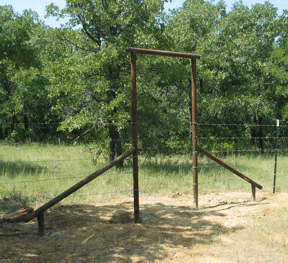
This is the walk-through gate on the west side of our new place. When I saw the finished gate, unexpected feelings and insights came to me. Before the gate, we had some clumps of trees with a couple of little glades here and there. Now, the gate separates two glades and it actually beckons one to walk through to the next place. Last week, one place. This week, two places, one on each side of the gate.
I saw the gate as a portal, like the lone doors or openings in thin air that I’ve read about in books or seen in movies. And I had the sense that the gate was a portal into unknown opportunities or places. It was moving.
As a knitter, I’m used to creating a new thing from string. Building into the earth is a whole different feeling. People study this phenomenon, you know: trying to understand the culture and thought involved in carving out personal spaces.
On the textile front, I’m making progress on the snowflake quilt. I’m almost done quilting it. Quilting hasn’t taken that long. Don’t know why I didn’t just get on with it before. Probably some other deadline reared its scary head.
Speaking of deadlines, I sent off my latest INKnitters article today. It is about my friend Suzanne Correira, who is the owner of Fire Ant Ranch, and purveyor of fine fleeces, yarn, and finished goods from her own happy, well-cared-for sheep. Look for it in the fall issue.
INKnitters Magazine Review
I Googled INKnitters reviews magazine the other day, and found lots of reader comments and reviews. Here’s one. They were fun to read. No surprise that most knitters loved the articles. That made me proud to be one of the long-standing article contributors to the magazine.
One lady commented: I like the articles, but when I look at some of the samples, I wonder “What were they thinking?” I had to chuckle. Some of my own samples are a little odd, and certainly not to everyone’s taste. The important thing is not “what were they thinking?” but “Hurray! They were thinking!”
Creativity requires lots of thinking. I come up with tons of ideas. I explore some of them beyond the thinking stage, with samples or sketches. But only a very few turn out to be great ideas. It’s the knitting version of the saying “You have to kiss a lot of frogs to find your prince.”
I was very pleased to see how many readers get ideas from the articles, even if they don’t like the particular samples shown.
FeltedBagKAL Done

I finished my little felted bag—the first one I’ve ever made. It was fun to see the how knitting changed in the felting process. I tried a decorative sewing stitch on it, but found that it was too hard to regulate the feed of the felt through the machine. Obviously, machine stitching on felt requires stabilizer on top and bottom. Here’s my sampler of several stitches.

I’m calling it done, even with uneven decorative stitching. It’s cute, and I’m happy with this first effort.
We drove a long way to visit family over the Labor Day weekend, but I didn’t bring any handwork with me. My poor old hands have been so numb and tingly lately, I decided to give them a rest. Instead, I brought my computer along and digitized a couple of designs for the embroidery machine. I’m building a collection of samples of machine-embroidered sweater knits, which I will share as it grows.
Snowflake and Fencing

This one’s called Snowflake Dreams of Spring , and I started it last year in hopes of entering it into the Spring International Quilt Festival in Chicago. Time slipped away, and I didn’t make the deadline. Also, I felt I had to redo some of the quilting and that put a damper on the project.
Looking at it today, after several months have gone by, the quilting wasn’t as poor as I thought. May have to pull out a few inches and straighten it up, but not nearly the wholesale undoing that I dreaded.
My goal is to get the quilting done by the weekend, so I can start sewing on my crocheted trim and lots and lots of buttons.
Last week was the first week of school, and I managed to sew one pair of Capri pants for fifth-grade Eva.
It was also the week that we started in earnest to build a fence around our new place, where we will be building a house. My Dad and his helper did most of the work on it, and I did a little. All the metal posts are set in concrete, and now a welder is attaching braces and so forth. Next week: stretching barbed wire to keep the cows out. You’ll be reading a lot more about our house over the next couple of years.
Ladybug Wall Hanging Done
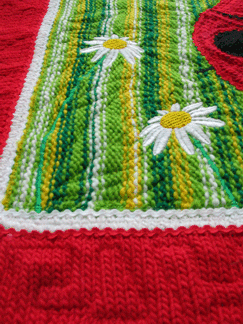
Today I sewed the last of 89 buttons on my Ladybug wall hanging. Probably everybody knows this trick already, but I learned it only recently from Sue Hausmann’s Sew Fast, Faster, Fastest. Double your sewing thread, and thread it into the needle, so that you have two threads going through the eye. Knot all ends, giving you four threads with each stitch. A couple of stitches through the button, a couple of tacking stitches, and you’re done!
Here’s a tantalizing detail of the wall hanging. I want to write about it for a publication that doesn’t want a project to have been splashed all over the internet (or even modestly published on a little-known blog) before it is published with them.
The piece is knitted on the Ultimate Sweater Machine (but could also be hand-knitted), pieced, machine-embroidered, quilted, embellished. It has a bold red ladybug with black spots, surrounded by this green and yellow background. Wide red borders and yellow corners finish the piece. The 89 black buttons, in a wide range of diameters, are spaced randomly all around the border, to pick up the dot motif from the ladybug. This photo was taken before the buttons were sewn on. I’ll let you know where to see the whole thing as soon as I can.
Unfortunately, or fortunately, depending on your point of view, the use of 89 buttons barely made a dent in our button stash.
Hill Country Weavers, Austin, Texas

My husband went down to Austin earlier this week for business. Eva, Ella, and I tagged along. We stayed in the Holiday Inn at Town Lake, and I would recommend it if you’re planning a visit to Austin. Go ahead and pay $10 extra for a lake-view room. It’s worth the extra money. It is practically downtown and, more importantly, it is within quick driving distance to Hill Country Weavers, a knitter’s paradise.
I am proud to say I have been a customer from the 1980s. Then, weaving and spinning supplies were much more in evidence. Now, knitting yarn has taken over the store. And what a wonderful selection! Words won’t do justice to the hundreds of yarn choices: imports, domestic yarns, novelty yarns, all colors of the rainbow and more. Hand-painted furniture doubles for yarn display, and there are some wonderful finished scarves for sale.
Luckily, Eva and Ella distracted me from spending hundreds of dollars. But I’ll be back! I spotted a pile of Manos del Uruguay yarn in one room. That yarn has always appealed to me, and I can still hear it calling my name, even though we have been at home for two days. One color-way in particular will draw me back—rich, dark autumn shades and black, with flashes of brilliant color.

Last time I was at Hill Country Weavers, over a year ago, it was a weekend, and this porch had knitters draped all over it. The store was full of them, too. This time, on a hot Tuesday afternoon, the store was moderately busy, but there was room on the porch for these two beauties.
If you’re in Austin, make time for a trip to Hill Country Weavers.


