Taos is Tiring!
What an exhausting week! But it’s that good kind of exhausting, where I’ve done exactly what I love to do all day long.
Tuesday, we did the “Freeform Knit/Crochet an Underwater Scene” class. Stephanie combined elements from several pictures for the background, and crocheted a fish to live in the scene. It is a work in progress, she says. She plans to add some yellow seaweed to show the fish up a little better.

I made progress on my own crocheted underwater scene, adding a few pieces to the foreground. Charlene, another class participant, showed me how to achieve mitered corners for my binding. Hurray! It’s a very sensible technique, now that someone has explained it to me.

We knitted “Cables, Bobbles, and Braids” on Wednesday. So impressive and so easy to learn! We worked so hard, I forgot to take photos.
Thursday, we made buttons, buttons, buttons. The polymer clay buttons were favorites, of course, and everyone made a bunch. As usual, I was inspired by the color combinations that people came up with. Now I want to go home and play with clay for a few days. We also made felt buttons and needle-worked buttons. They aren’t quite as exciting as polymer, but we got some very nice-looking specimens by the end of the day.
Charles and the girls visited Sand Dunes National Monument yesterday. Charles said, “We’re going to go play in a huge sandbox with no cats around to mess it up!” They were three very sandy persons at the end of the day.
An Old-Time TextileFusion Tablecloth
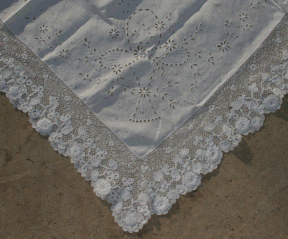
People have done TextileFusion for a long time! Here’s a fabulous tablecloth that combines an Irish Crochet trim and eyelet embroidery. I don’t know its history, except that it is the last piece I bought before we moved away from Sheffield, England. It is in perfect shape.
In other news, the heart wall hanging is getting closer and closer to finished each day. Some days I get a lot of buttons sewn on, other days only one or two.
More Irish Crochet

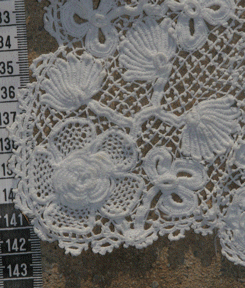
This little collar is a great example of crocheting over a core thread or padding, which was a common technique in Irish Crochet. What you do, is wind thread around your finger or something similar. Then you make as many single-crochets as possible over the resulting thread ring.
The rings in this collar are plump, which means the crocheter made many rounds with the padding thread before starting to crochet. They are satiny, which means there are lots and lots of single crochets. The criss-cross threads in the center of some rings are done with a needle and thread. I can’t tell whether they stabilize the ring or whether they are simply another detail in the design.

The skinny threads and the plump rings and the medium-weight of the crochet make this piece very intriguing to the eye. The collar is damaged around the inside edge, but I mainly wanted it to illustrate padded crochet. Collecting is so much easier if you aren’t a perfectionist.
Taos and Stone Pillar
The Taos Wool Festival is almost upon us! I’ve been packing for days. When I drive to teach instead of fly, I can think of lots more stuff to bring. Some might say I bring way, way too much. Hope there’s room in the van for clothes!

Last week we had a stunning orange sunrise and a rainbow that went unbroken from horizon to horizon! Our pillar (read about it here), was lit by that orange light and, with the rainbow in the background, we couldn’t resist a photo. This is a view to the southwest.
More Heart Buttons
After reading the post before this, one of my regular readers (Hi Mom!) said, “When you put all those buttons on the background, they obliterate the patterns.” Hmmm. The patterns look pretty good. Do I really want to obliterate them? Nooooo so it was time for another button session.
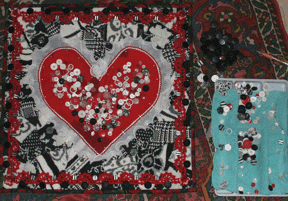
Here’s the wall hanging with buttons randomly sprinkled over the heart. I’m fond of this look, but it really looks better in person. The flash makes it look too stark. There are already 60 or so buttons sewn around the edge. Can you see them?
And my button tray is there on the right, with a washcloth to muffle the clatter of buttons. I didn’t want to wake my girls up with the noise. They would probably want to get up and play buttons, too.

I like this alternative, too. It’s a little rough in this picture, but how about these stylized button flowers? They probably need rearranging.
Well, there’s still time to think about it. I’m sewing frosty buttons on the pleated trim around the heart, and I worked out a way to hide the ends of the trim.
Comments and suggestions are welcome!
A Personal Crochet Revival

Having done a lot more crochet lately, I trawled around to find out what crochet groups Yahoo had to offer. Wow. I found some just right for me. One was the Irish Crochet Lovers group. I fell in love with Irish Crochet in the early 1980s, when I found some reprints of old Irish Crochet instruction books.
While we lived in England, I bought three pieces of Irish Crochet. This one must have had sleeves originally, but someone cut them off. Yes. Cut them off. That is why I could afford this otherwise fine piece of crochet.

Here it is, a little closer. Look at the variety of motifs! They would have been crocheted separately, then attached to a foundation. The background crochet was worked between the motifs. The completed piece was removed from the foundation.
The measuring tape in the picture below shows inches on the right and centimeters on the left, which gives you an idea of how tiny the stitches are. The motif is at the front bottom corner of the jacket fronts. To think that many Irish Crochet pieces were worked by children! I read that crocheters embedded wire into a cork to use as a crochet hook. We are so lucky nowadays.

Adventure on French Amazon
There’s a brag in this post, so beware! I was looking for crochet pattern books. My search brought me to amazon.fr, the French branch of amazon.com. The French word crochet means “hook” as well as referring to the craft of crochet.
A search on the keyword ‘crochet’ gave me all the books about crochet, and lots of books about some character named Capitan Crochet. Captain Hook, of course! I love, love words, and find this cross-lingual word play delightful.
I did end up ordering from amazon.fr, even though I don’t know any French (aside from the all-important ‘crochet’ and ‘tricot’). It’s pretty easy, because the buttons and icons look the same, even thought they are written in French. Also they’re all in the same places, so if you’re familiar with amazon.com, you don’t have much trouble with the other languages. Naturally, a VISA card speaks all languages.
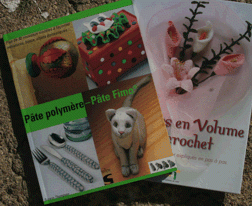
Here are the books I got: a crochet book and a polymer clay book. Wait! Who is the author of that polymer clay book? Why, it’s Suzann Thompson! Yes, my polymer clay book was translated into French, shortly after it was originally published in 1999. The layout is exactly the same; only the words are different. It is called Pâte polymère— Pâte Fimo® in France, The Polymer Clay Sourcebook in England, and Polymer Clay for Everyone in the US.
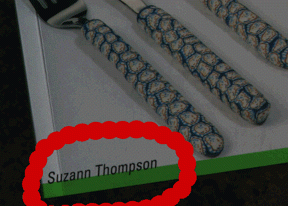
Thank goodness the French version is still available after all these years. The US version is out of print, but I still have a few for sale.
Heart Bound and Buttoned Again

Black was my original choice for the binding around the heart quilt. I took it along with me to The Flying Needle, Stephenville’s wonderful quilt shop (on the loop, near Ace Hardware). I tried several black fabrics with small white patterns. They were…okay. Can you sense the lack of enthusiasm?
After some prowling around, I found red tulips and green leaves on a black background. Wow! When I placed the heart on that fabric, it perked right up! It’s funny how some combinations practically yell, “Me, me! Pick me!”
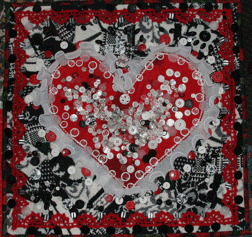
I trimmed the piece—always a nerve-wracking task for me. Once it was bound, I sewed on that pretty red crochet trim. Unfortunately, it was too long, and I had to cut away four motifs. It ruined the beautiful corners, but that’s okay. I will just sew something over them.
We held another button session. Here’s one possibility. This project may make a noticeable dent in our button collection. Yay!
Huichol Yarn Painting

When I started writing this, it occurred to me that a lot of people are painting yarn these days. But this post is about a painting -made- with yarn. The artist spreads a layer of beeswax onto a board and presses the yarn into the beeswax. The best-known yarn paintings are by the Huichol Indians of southern Mexico. The internet has lots of information about Huichol yarn paintings; you just need to search on those terms.
I love all fibery, textilish things, and Charles and I both love decorative art, like pretty plates, blown glass, embroidery, mosaic, and all that. So when I saw a set of yarn paintings at a shop in Austin, I knew I would be back. They were beautiful and beautifully made. I didn’t think the opportunity to buy such fine work would come along again anytime soon.
This yarn painting is by Maestro Cantadero Chaman Hiuveme (could also be Niuveme), or Master Singer Shaman Hiuveme. He or someone wrote in Spanish on the back, explaining the symbolism in the painting.
Es el sol, la sangre del venado y el fuego por eso lo vemos todo rojo. El ojo de dios y las mariposas mos anuncia la lluvia. Os Huicholes le Resamos y oferenos el ojo dios paca que llueva y la motierra no este caliente y asi poder sembros.
Por eso habmos fiesta ofendas y tejuino, bela para los dioses. Nos escuchen el canto de suplica
Echo por El Maestro Cantador Chaman Hiuveme

Here’s one interpretation of the words:
It is the sun, the blood of the deer, and the fire, for they all go red. The eye of god and the butterflies announce the rain. The Huichols repay and offer the god’s eye [the diamond shape at the center top] for the rain and so the land will not be too hot, and so give power to our planting.
And for this we have a party of offerings and [?unreadable?] beauty for the gods. They hear the song of our request.
Made by the Master Singer Shaman Hiuveme
Caught Up in Cables

“Cables, Bobbles, and Braids” is one of my workshops at the Wool Festival at Taos (and, I hope, at some other venues in 2007). The workshop samples are coming along nicely. I’m really proud of this sample, because it shows how cable stitches are related.
Use your hand or a piece of paper to cover the top part of the sample. You will see two simple cables going up the swatch. They twist in different directions. Okay, now move your hand or the paper to cover the left side of the sample. You should see one cable going merrily up the length of the swatch.
Now look at the whole swatch. Do you see how the two simple cables join up to become a different kind of cable? Barbara Walker calls it the “Horseshoe Cable” or “Double Cable,” but it’s really two regular cables, side-by-side, twisting in opposite directions.
In my workshops, I try to show people how to see relationships among stitch patterns in knitting. It amounts to seeing, with your brain fully engaged. Just like any subject, when you develop a deeper understanding, you are able to appreciate it in a new and satisfying way. Yes, you can enjoy knitting even more than you already do!
We have six hours in the Taos class, so we’re going beyond the basics. To begin, we’ll knit cable, bobble, and braid samples. Then we will design a cable sweater together. Finally, we’re going to design our own cable pattern stitch, either as a class or individually.
Does this intrigue you? Well, you still have a few days to sign up for workshops at Taos, without a late fee.


