
Trout Just Love Angora!
I typed “angora yarn” into the Google search box and pressed ‘enter.’ The third listing from the top was “Pure Imported Angora Yarn—www.fishusa.com—FishUSA has 100% purl Angora Yarn for fly tying or knitting.”

FishUSA? Fly tying? Well, sure enough! For $1.95 you get 11 feet of 100% angora, three-ply yarn from France, wound on a card. You can use it to knit a very tiny sweater or to tie a fly pattern called “sucker spawn.” According to bigyflyco.com, fish love to eat eggs, and this little pattern is meant to look like the egg sac of a sucker, which migrates to the tributaries of Lake Erie in early spring. Angora yarn is the preferred material to tie this fly, according to FishUSA.com.

Current fish fashion features angora in fluorescent chartreuse, peach, pink, yellow, and orange; salmon egg pink, red, and a few pale colors. FishUSA has regular-size balls of angora, which one could knit, but the range of colors is sadly limited—no fluorescents.
The Great Lakes Steelhead and trout really go for the angora sucker spawn fly. Obviously, they have very good taste in yarn.
Images from bigyflyco.com and fishusa.com.
More Wool and Mohair Warehouses

Alpine, Texas is in a valley, surrounded by three different mountain ranges near Big Bend. You can see some of the grassy peaks in the shot of the Big Bend Wool and Mohair Company, which was not too far from our hotel. Like most of the wool and mohair warehouses we saw, it was next to the railroad track.
Alpine is the home of Sul Ross State University, where Charles was attending a conference. The university may be one reason why such a small town is such a great place for book lovers! We spent a long, long time at Front Street Books, which has new and used books. I bought a stack of old needlework and craft books. Charles chose a bunch of books for me to give him for Christmas.
Volunteers run a bookstore called Re-Reads, which helps support the Alpine Public Library. I struck gold there: a Perry Mason casebook, featuring four full-length Perry Mason novels, three of which we didn’t already have! And for only $2.00. A bargain at twice, three times, four times the price. We are fans.

Alpine has a yarn store, but it closed at 11:00 a.m. on Saturday. I arrived, ready to shop, at 11:45. Inside, I saw sun-faded sewing notions on the window sill and a sad little display of crafts on a table. A lone bag of yarn was strewn on a shelf. A room further back was too shadowy to see into, but I feel certain I didn’t miss much. I won’t give you its name, because you can look it up if you’re ever there.

As we drove back eastward, we saw the Texas Wool and Mohair Association warehouse in Mertzon, Texas, which is west of San Angelo. The sign at Ballinger Wool and Mohair looked like it was recently painted, so I think they’re still in business. I’d like to check back at these places in the spring when the wool comes in.
Wool and Mohair in San Angelo

Who knew we would be back in San Angelo so soon? And without kids? And with a little extra time to spend? I wanted to find a wool and mohair warehouse and talk to someone about it. We found Western Wool & Mohair just off Highway 67 near downtown.

We found the owner, Linda Turner, in a back office with two friendly dogs. They stayed to guard the office, while Linda took us on a tour of the building. “This isn’t the best time to see a wool warehouse,” said Linda. “You really need to come back in the spring.”

Late in spring, the warehouse is filled, upstairs and down, with sacks of wool. Buyers from anywhere in the world come by and pull a little wool out of a bag to check it. If the wool meets a buyer’s need, they bid on the lot. Some ranchers prefer to accept or decline bids on their own wool, while some rely on Linda make the decision to sell or not.

Even at this late time of year, we did see some bags and bales of wool at the warehouse. The big bags are packed tight and weigh between 150 and 200 pounds. They are almost 5 feet tall. “This bag isn’t worth much,” said Linda, pointing to a bag of black wool. “Most buyers want the fine, white wools like Ramboulliet.”

Once a lot of wool is sold, warehouse staff bind sets of five bags into bales. The numbers written on the bales show who the seller is, what lot the bale belongs in, and the weight of the bale. The bales on the right weigh 936 and 850 pounds.

The wool goes primarily to carpet and fabric manufacturers. I’m afraid hand-knitting yarn is not a very large segment of the wool trade.
Knickerbocker Yarn
“What’s a ‘knickerbocker’?” asked Charles. He was reading a book, in which a woman was described as having the ‘best knickerbocker lineage.’
“Eye-oh-no,” I said, because I was too busy crocheting to enunciate. Then I said the words dreaded by schoolchildren everywhere: “Why don’t you look it up?” Had I said this to 11-year-old Eva, she would have said, “Aw, Mo-om!”

Not being a schoolchild, but an intelligent and curious grown-up, Charles looked it up right away, with no whining. The lady in the book was descended from the Knickerbockers, a nickname for the original Dutch settlers in New Netherland, which was later split into New York and New Jersey (USA). There was actually a man surnamed Knickerbocker, who was one of those original settlers.
“Hey, here’s Knickerbocker yarn!” said Charles. He’s a good guy—always thinking of me. Knickerbocker yarn is flecked with different colors. A surprising (to me) number of web sites give information about this yarn, which is also called Knicker yarn or Nepp yarn. You card small balls of wool or silk noil into a longer fiber and then spin it all up together.
So I guess this pretty yarn, handspun by my friend Joan L., would be Knickerbocker yarn.
Hints from a Judge
Judging the Garment and Home Accessories Competition at the Taos Wool Festival was hard work, but it was also fun and very satisfying. My fellow judges Donna from Colorado, and Deb from New Mexico, were experts in dyeing and weaving, which made for a great judging team.
Luckily we didn’t have to drive all the way home from Taos in one day, so Eva and I had time to shop at the Wool Festival. It was a sloshy mess, but the true fiber lovers were there and they were spending.

We made the round of the Festival booths, many of which had buckets and interesting layouts so that the merchandise could stay dry. We came back to Plain & Fancy Sheep & Wool Co. (Henderson, TX), so I could buy this hand-dyed yarn. Reminds me of pansies or crocuses. I don’t have a firm plan for it yet. The company, which is owned by Ken and Grayce Aggen, doesn’t have a web site, but I would be glad to send you their email address.

Ellen Sibelius’s booth was filled with fantastic knitted creatures of her own design. We bought the Monarch Butterfly pattern and a pattern for a dragon. She had many more, including dinosaurs. Ellen doesn’t have a web site, but if you’re interested in her patterns, I can send you her email address.

Last year I bought a color sample card from Weaving Southwest, whose gallery and yarn shop are on the main street of Taos. All year long, I plotted and planned the colors I would buy to make a wall hanging. Weaving Southwest was our last shopping stop, and it was a dry and warm haven. Here’s what I bought.
Then we packed up and drove through the rain and fog in the mountains and the rain on the plains. I enjoyed seeing my favorite sights in the Texas Panhandle Plains: grain elevators, mills, gins, and trains. Oh, and it was all in the rain.

Back to Taos

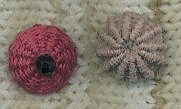
I never finished telling about our trip to the Taos Wool Festival, so back we go, in spirit, to Taos. My button class was on Thursday. We had a great, great time, but it was so exhausting that I didn’t have the energy to pack up afterwards. Thank goodness I was in the same room the next day. We were so busy that I didn’t take any pictures, but here are the buttons I made as examples in the class. By the way, students will make a button like this in my “Wooly Buttons” class at the DFW Fiber Fest.
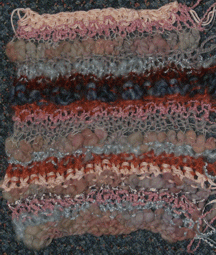
Friday was Color Composure, and I had another great group of people in the class. The approach of the class is to start simple, with one color and various shades of that color, then to add another color and then another, until there are lots of colors. This sample, by Emilie, was the class favorite. Emilie had muted pastel colors to start. She was not convinced that the new colors she added would look good. “Keep going,” I always say, “because the new color will lose its relative importance as you add more rows.” The class cheered her on.

Then we did collages with torn-out magazine pages. The idea is to collect pages with your assigned color, then see how they fall into color families. We ran out of time before we could knit samples based on the collages. Too bad. The assigned colors for these collages were turquoise and green.

Saturday was the first day of the actual Wool Festival. After a rainy start, the day turned gorgeous. I didn’t get to shop, though, because I was busy judging the Garment and Home Accessories Contest. Next time, more about judging and about the yarn I bought on rainy, muddy, squishy, sloshy Sunday at the Wool Festival.
Wool and Archeology in San Angelo
My husband went to a Texas Archeological Society meeting in San Angelo, Texas, last weekend. We tagged along, because San Angelo is a quirky and interesting city. It has a small university, a big art community, and attractions like the International Water Lily Garden. It’s big enough to have a lot of commerce, but not so big that you can’t find your way around. You can see a lot of local flavor in the businesses, but the big retailers and food chains are moving in along the loop around the town.
A quick check of the yellow pages revealed a category for “Wool.” West Texas was a big producer of wool and mohair until the government subsidies were removed. Still, for San Angelo and surrounding areas there were a dozen listings under “Wool,” which included:
Ballinger Wool & Mohair
Eldorado Wool Co
Ozona Wool & Mohair Co.
San Angelo Wool Processing
Santa Fe Grading
Sonora Wool & Mohair Co
Southwestern Wool & Mohair Inc
West Texas Wool & Mohair Association
Western Wool & Mohair Co.
Wool Growers Central Storage
You’d think that such a wooly place would naturally have several yarn shops. Nope. The only listing under “Y” is “Youth Organizations and Centers.” No category for yarn, nary a yarn store. Oh, the local Hobby Lobby probably has yarn, but it’s not the same.


San Angelo makes up for this sad lack of yarn by having lots of art and artists. We visited the Chicken Farm Art Center. Among the wonderful painters’, potters’, and batik artists’ studios, we found an artist who works in mosaic. Her name is Mary Swain, and here is some of her work. I love how she uses natural materials among the tiles. This mirror frame has antlers worked into the design. Another mirror frame had fossil snails in the design. Mary coats the finished mosaic with some sealant, which gives all the components a glossy, wet-looking finish, and unifies the design elements. She said that a mirror frame takes her about two weeks to complete.

Mary’s mosaics are featured in other parts of the Art Center, like this step in the Gecko Gallery. She also decorated parts of Inn of the Arts, a bed and breakfast on site.
The Adult Literacy Council was having a used book sale–$1.00 for hardbacks, 50 cents for paperbacks. We couldn’t pass that up. A shop for really fabulous and colorful fashion and home decor was J. Wilde, also downtown. They had lots of knit and crochet fashions, plus lots of garments that combined knitting and crochet. Hey! TextileFusion at work!
My three-year-old ran out of energy about 4:00 in the afternoon, so we went back to the hotel, but not before I got a shot of this cute San Angelo mosaic is by an unknown artist.

Polymer Buttons Find New Home!
Nana Sadie Rose sews and sells tote bags for knitters, crocheters, and teachers, using fabric that her customers choose on-line. The bags are roomy, full of pockets, well-proportioned, pretty, and beautifully-made. Lucky knitters who own Nana Sadie Rose bags just love them.
You can probably imagine how thrilled I felt when Nana Sadie Rose asked me to make polymer clay buttons for some of her bags. She will soon have bags available in this retro-kitty fabric with great colors. I mixed clay to match the turquoise in the print and then added other colors to make stacked buttons.

These swirl buttons match the brown and pink kitty footprint and polka-dot fabrics. The buttons look delicious, like chocolate and raspberry crème.

As you know, a knitter can always use another tote bag. A Nana Sadie Rose bag is the perfect gift for the knitter who has everything. Order before mid-November, if you would like your new bag delivered before Christmas.
One Down, About 600 to Go
I’m freeeeeeeeeeeeee! For those of us who filed an extension on our 2005 tax returns, today is the last day to get them in the mail. And we did it with over an hour to spare, even though our little post office closes at 3:45! Hurray! There’s even better news. I am caught up with my bookkeeping for the first time since Ella was born 3 years and 9-ish months ago. Hurray again!
Tonight I will celebrate by making buttons, which is one of the several hundred things I would rather do than complete tax returns.
My poncho is almost finished, due to many hours on the road to the Taos Wool Festival and evenings in the hotel. My pink and black yarn collections are visibly smaller. The poncho still needs trim. I’m considering an alternative to fringe, but don’t know what it will be yet.
Quilty Success
My computer was ready to pick up on Friday, a day later than promised. “It took a lot longer to download the updates than I thought,” said the computer repair guy. If he needed a day longer to get it back up to speed, it would have taken me a week longer, so I still came out ahead. But, oh, I missed my little computer!
He managed to install Windows Service Pack 2, a feat which I had not been able to accomplish, even after reading lots of Windows help files. When they recommended changing something in the register, the mysterious file that contains the DNA of the computer’s brain, I decided to turn it all over to a pro.

Enough about computers! We got home from Taos on Monday night, completely exhausted. We had a wonderful week. On Tuesday, Joy of my favorite Joy’s Fabrics (Stephenville, TX), left a phone message, saying “I have your quilt and your ribbons. Come by when you have a chance.” She emphasized the ‘s’ in ribbons.
The Town and Country Quilt Guild in Stephenville puts on a quilt show every year. It is called “Threads of Texas.” Joy was kind enough to deliver my snowflake quilt and pick it up, since we were away in New Mexico. The quilt won second place in “Mixed Media, Medium Size” and it won a Merit Award. I need to find out what that one is about.
More about Taos next time, also poncho news and eventually a few notes about entering your work in contests.