Crocheting Rexlace
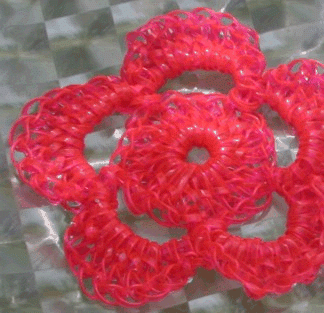

My daughter and I were drawn as if by a magnet to the bins of brightly colored Rexlace at a craftstore in Houston. We left with several spools of the plastic lacing, with plans for some knitted project. Knitting it was more difficult than I bargained for. However, crocheting Rexlace is an entirely different story! It crochets very well with a size I/9 (5.5 mm) or larger crochet hook.

Rexlace comes in lots of colors. My favorite ones are the neon transparent colors, which I used to crochet these flowers. Light shines through them, as you can see in the photo with the cute model holding the Rexlace flowers up to the sun.
Here are my tips, so far, for crocheting with Rexlace:
Work in warm surroundings—warm weather softens the plastic and makes it easier to crochet.
Pace yourself for a large project, because crocheting plastic puts more strain on your hands than crocheting yarn.
If you’re going to glue your crocheted Rexlace to something, make sure you have the right kind of glue. For the project shown here, I needed an adhesive that would glue plastic to vinyl. We found it at a hardware store.
Judi & Co. for Luxury Hand-dyed Yarns

The yarn in the picture is called ‘Cherry Bonbon,’ which is perfect because it looks so yummy! It is hand-dyed Cordé, by Judi & Co. This company has beautiful hand-dyed yarns in amazing textures. They carry sparkly ribbons, fringed ribbons, a hand-dyed rayon raffia, sequin yarns, and more. They’re all beautiful.
I crocheted with Cordé for my big secret project, which is almost, almost, almost finished. Hurray! I’ve been working on it so much and so long, that I forgot what life was like BP (Before Project).

A decade or so ago, few fashionable people would mix greenish blues and yellowish greens. Three decades ago, I painted a picture in art class with green, blue, and purple high-rises. Hey, all those colors were based on blue, weren’t they? My high school art teacher said, “Normally I wouldn’t recommend using the warm purple with the cool blues and greens…but it seems to work.” As my Mom has said, I was ahead of my time, because nowadays, you find blues, purples, and greens combined all over the place.
The variegated cotton in the photo (Plymouth Yarns Fantasy Naturale color number 9480) combines teal and peacock, both greenish blues, with yellow green and a little tan to rest the eyes. They are colors whose time has come. My eyes love to feast on this yarn, while it waits its turn to be crocheted.
And speaking of great colors, how about our wisteria?! This is my dream front door, surrounded by blooming vines. Someday, oh someday, we will have a big arbor covered with blooming vines in the spring and shading leaves in the summer. Someday.

Tiny Yarn Scraps in Use
Diana just finished a Koigu shawl, and has a number of scraps as small as 2 inches. She’s thinking about knitting a landscape wall hanging, and using the snippets to embellish it. She commented that the short lengths of yarn from the sample card in my last post could be used in the same way.

Her comment reminded me of ‘Confetti’ yarn, which I learned to make when my friend Hazel taught a workshop on the technique several years ago at the Hallamshire Guild of Weavers, Spinners and Dyers in Sheffield, England.
For some reason I don’t remember, I had cut one-yard lengths of many kinds of pink yarn, and then never used them. So I cut them smaller and drum-carded them in with natural white wool and some dyed wool to enhance the color. Here’s the pink yarn that I spun. I plied it with pink sewing thread. That gave it even more pinkness, and kept the yarn from being too bulky.

If you’ve used a drum-carder, you know that the fiber from the big drum is what you spin. The smaller drum catches the very short fibers and snarls. Well, when you add short pieces of yarn and stuff to the carder, the small drum gathers a great many of the small bits.
After carding a more colorful batch of scraps, I just couldn’t bear to trash the fibers on the small drum. So I took them off and spun them into this nubbly yarn. It’s still waiting for the perfect project to come along.
No matter which fiber you use, you end up surrounded by a halo of little scraps on the floor around you and your spinning wheel.
Plymouth Rocks

Plymouth Yarns has always carried great basic yarns. I like their Indiecita Sport alpaca, and they now have alpaca boucle and baby alpaca yarns, too. Plymouth’s Galway Worsted 100% wool comes in a thorough color range, including some heathered yarns and nep yarns (tiny color blobs in the yarn).
Now I have another reason to like Plymouth Yarns: 100% mercerized cotton Fantasy Naturale. The sixty-nine colors of the four-ply, medium weight cotton include some variegated and some very interesting yarns with separately-variegated plies.

Whoever mixed the colors of the multi-ply variegated is really good (color number 9995). It gives the sense of terra cotta, but has contrasting bits of teal and golden yellow. A touch of black adds a delicious dark accent, and taupe provides a calming background to unite the colors. The yarn looks great in the skein, but I think it looks even better crocheted.
This yarn passes the hair test, so I need to make a sweater out of this yarn. The hair test is simply: Does it look good with my hair? I do go around checking yarns and fabrics by holding my hair up to them.
The hand test works well in fabric stores: just walk down the aisle of fabric, brushing the fabrics with your outstretched hand. It’s amazing how the color of your hand changes against the different fabrics. Anyone else have “tests” for yarn and fabric?
Crystal Palace Fun
Have I made anything in the last few months? Besides a poncho, that is. Yes, but not that you can tell from my blog. Yes, I’ve been crocheting like crazy! But I can’t tell you what I’m crocheting. Yet.

I have used some great yarns for my big, secret project, like these from Crystal Palace Yarns. They are such fun! And the colors are wonderful. I especially love the wildly textured carry-along yarns, like Squiggle and Popcorn (the three yarns at top left of the photo).
You may have knitted or crocheted with yarns that have nubs and squiggles like these. Did you notice that the nubs and squiggles often end up on the purl side of the knitting? This is the perfect time to use the purl side as the “public” side of the knitting (as author Maggie Righetti has so aptly named the side of the knitting that you wear for others to see).

And if you crochet, have you noticed that the nubs and squiggles end up on the back of the stitches? This is probably okay if you’re crocheting back and forth, because they would be evenly distributed front and back. But what if you’re crocheting in rounds? All the good stuff will be on the back! So, make the back into the front.
The brown sample is Crystal Palace Yarns Party, a lovely shaded ribbon, held on the last round with a strand of Popcorn. I crocheted that last round from the back, so the popcorns would show well on the front.

The pink and green sample is Blue Sky Alpacas Cotton held with a strand of Crystal Palace Yarns Squiggle. It is such a cute yarn. Again, I crocheted the Squiggle round from the back side, so the squiggles would show on the front.
What are these samples supposed to be? I can’t tell you! I think I can probably tell you in summer, if you don’t guess on your own.
Blue Light from Where?
In my last post, I theorized about the blue glow around passing vehicles, and the blue light reflecting from a nearby lake, during a sandstorm. My explanation was elegant. It made perfect sense. But I was wrong.
My Uncle Christian, who worked for many years as a chemist in the textile industry, and who knows a lot about color, pointed out the flaw. He noted that blue light has a very short wavelength, and the blue light from the sun would have been largely absorbed by the orangey sand and dust in the air. So my theory about the blue light reaching the earth in greater amounts than usual was not correct.
He thinks that the blue light we saw glowing around the cars and pickups (and which I unfortunately didn’t capture with the camera), could have had something to do with electrostatic charges that build up during sandstorms. Electrostatic charge builds when electrons are blown off or rubbed off of dust particles in a sandstorm, or when you brush your hair in dry weather.
We are still trying to find out exactly what the phenomenon was, but it could be that the vehicles moving through the charged sand particle caused a discharge, which we saw as a blue glow.
The same thing probably was the case with the waves on the lake. And I wonder if the electrostatic charge of the sandstorm had some effect on the week-old fire that suddenly came back to life that day.
There’s a lot of literature online about sandstorms in space, particularly on Mars. Here’s a bit of information I found at http://www.valdostamuseum.org/hamsmith/solsyscol.html.
Showers of electrons striking the moon’s thin atmosphere give rise to a blue glow.
Here’s another interesting thing about blue, which I know is true. No speculation this time. You have heard of red-hot, I’m sure. Of course we all know that white-hot is hotter still than red-hot. Believe it or not, there is something even hotter than white-hot: blue-hot.
You know the blue flame from a gas stove? It’s hotter than an orange/red flame. The gas burns very pure, with not much waste, so it’s hotter—and blue!
Color Theory in Action

The skies were brown last Saturday. High winds filled the air with sand and dust, blotting out everything beyond a quarter of a mile. Charles went out for the Saturday newspaper, and came back telling of white caps on the normally calm Lake Proctor.
The afternoon brought excitement to our area. The weekend before, a neighbor burned two big piles of brush. The embers were still alive enough, after a week, for the strong wind to whip them back into flame. Volunteer firemen and others drove back and forth by our house, trying to figure out how to get close enough to the fire to do any good. We kept an eye on the comings and goings, and I noticed that the trucks and pickups reflected a cool, blue light.
“Let’s go for a drive,” Charles suggested. Everything had a bluish cast to it. We drove over the lake again. The same blue light lit the brown waves. We had to go back for the camera, and here are a couple of the pictures we took. The opposite shores of the lake are close, but the dust was so thick, we couldn’t see them.

So why the blue light? Thanks to years of reading about color, I think I know. Sunlight contains
every color of light. If we see an object as green, it is because the object absorbs every color of light, except green light. It reflects the green light into our eyes, and we see green.
The dust in the air was brown, which is a combination of yellow and red tones. The billions of dust particles in the air reflected yellow and red light, changing its usual path. The air was so thick with dust, that much of the yellow and red light was probably bounced right back into the atmosphere.
The light that finally made it to us down here on the earth was disproportionately blue. That’s why we saw blue light reflected off of cars and water, and why less shiny objects, like grass and our skin, looked bluer than usual.
I love knowing about color.

Toronto Yarn Shop is Fabulous!

My friend Joan turned eighty last week. Her daughters threw a surprise birthday party for her, and people came from far and wide to Toronto to celebrate. It was a wonderful weekend of talking, talking, talking and quite a bit of eating, too.

Toronto has an almost sinful number of yarn shops. I had one afternoon to look around on my own, so I went to Romni Wools, which was billed has having more yarn than anyone else.
My goodness.
I have never, ever seen so much yarn in one place. It was difficult to take it all in. Yarn in twelve-foot-high bins, yarn in stackable bins, yarn hanging from racks, yarn in laundry baskets, fancy yarns, plain yarns, expensive luxury yarns, and reasonably-priced yarns all vied for space in this huge and crowded store. The coned yarns, spinning supplies, and discontinued yarns were in the basement.

The visual stimulation is strong, and one of the people working there told me that customers often look around a while, then go next door for a calming cup of coffee, before coming back to make their final choices.
I had some specific colors and textures in mind, so I took my time to find several great yarns, which I’ll show later.
If you knitters and crocheters find yourself in Toronto with a free afternoon, Romni Wool (658 Queen Street West) is the place to go.

Textile Collecting—Andean Hat Inside

This hat is just beautiful. The gauge is 18 stitches per inch. The workmanship looks flawless, and includes pretty details, like the tassels and this tiny knitted ripple. I was much impressed at the subtle colors of this hat. Could they be naturally dyed?
Nope. Take a look at the inside of the hat. Those are the original colors. They are gorgeous, too, and a lot brighter. The outside of the hat must be sun-faded.

This knitter combined stranding with intarsia. One white stitch separates the bright color patches. That white thread carries all the way around the inside, while the bright colors stay within their own bounds. You can see the intarsia color change where the bright colors meet. It takes a great deal of skill to combine stranding with intarsia successfully.

* * *
Thank you to kat kat-knits.blogspot.com and woolwinder woolwindings.blogspot.com for your compliments on my hat model. She’s quite a show-off, and loves to be in photos. You would like her in person, too, because she is a sweet and smart and funny person, who loves yarn. And now, she’s FOUR! She’s so excited about that.
The Last Poncho Installment (for now)

A gorgeous, deep, glowing, burgundy microfiber chenille was in my yarn collection for about 15 years before the perfect project came along. The yarn would be gorgeous in the pink and black poncho I was making. Even though the last project I made with chenille grew ‘worms,’ this chenille was of much better quality (well, it was a lot more expensive, anyway). It would be fine.
It wasn’t fine. The chenille grew worms almost immediately.
In the meantime, Eva made a couple of ponchos with Lion Brand Fun Fur in the last couple of rounds. They looked so good, I decided to do the same on my poncho. Luckily the chenille round was only third from the end, with two mohair rounds after it. If you’ve worked with mohair, you know the impossibility of ripping it out, so I cut off those rounds.

This was right after Christmas, and Michael’s ran a sale on a number of wonderful yarns, including Lion Brand Fancy Fur and Fun Fur. They were $2.00 per ball—an absolute bargain! Two rounds of fuchsia Fancy Fur and two rounds of black Fun Fur later, my poncho was finally done.


