
A Week at Chautauqua

I’m away from home this week on an adventure unlike any I’ve ever had. It’s a conference for children’s writers at the Chautauqua Institution in New York, organized by the Highlights for Children Foundation. If you never had Highlights for Children at home, you will probably remember it from the dentist’s or doctor’s office waiting room.

The Chautauqua Institution is in a summer village on Chautauqua Lake. Some people live here all year ’round, but some only come for the nine-week summer season, when they can go to the symphony or the opera, see art exhibits, listen to lectures by very wise people, and go to church. There are art studios here for sculpture, painting, and pottery-making.

Chautauqua reminds me of the summer lakeside village in the book Gone Away Lake, by Elizabeth Enright. The lovely Victorian-era cottages (many are more like mansions) have names like Fernbank, Doll House, The Cambridge, and Waugh Place. The gardens are filled with flowers, and it’s fun to walk around because few cars are allowed inside.

Among many other high goals and ideals, the Chautauqua Institute promotes excellence and creativity in the appreciation, performance, and teaching of the arts; and encourages the exploration of important religious, social, and political issues. But can such a utopian vision be complete without…yarn?
Of course not! So you’ll be glad to see this. I like how “Fine Art” and “Luxury Yarns” are billed together on this sign.
* * *
I have always loved children’s books. I read them as a kid, when I was in college, after college (which was before my children were born), and after I had children. The pictures and stories make me happy. As a kid, I wanted to write and illustrate books for kids. In fact, I did write and illustrate one for my brother.
Then I pushed that aside to do what I thought all smart girls were supposed to do—get a degree in business or science or engineering. I chose science. Now I am coming back around to the idea of being a writer for children, and this time, I’m armed with a lot of general knowledge in science and crafts, and a lot of life experience. I’m ready!
I’m a Rockin’ Girl Blogger!
Wow! Thanks to Diana at KnitThisToo for tagging me as a Rockin’ Girl Blogger. It’s a great tag, because you get this fabulous button, and all you have to do is nominate your own Rockin’ Girl Bloggers.

I tag
- Knitting Painter Woman because her blog is so literate, often pleasantly opinionated, and sometimes bravely opinionated, in addition to having knitting content.
- Woolwindings, because she has made so much progress after knitting for such a short time, she knits a lot for preemies, she posts great nature and wildflower pictures, and she always comments on my blog.
- Gooseflesh. I haven’t visited her blog for long, but my breath was taken away by her sea creatures, which are crocheted from recycled plastic bags. Her blog shows how her designs evolve, with sketches and photos. Click on the flickr box for more photos.
- I would tag Knitnana, but she was the one who tagged Diana.
Diana knew my daughter would think it was so cool that I got tagged for this. In fact, the other day, she said, “Mom, your blog gets cooler every time I read it.” Thank you, Eva! You’re pretty cool, yourself.
* * *

I appreciate the concern of a couple of people about the flooding in our area. We are fine, and the bridge under water is only minor inconvenience for us. Some folks have flooded fields. I know one lady who lost her home and possessions, and there are others. We wonder why the Corps of Engineers allows people to build houses within the floodplain of the lakes.
But the rain has its benefits, too! We’ve had the best tomato crop in years. Aren’t they gorgeous?

Crocheted Flower Dresses!
Look at this gorgeous dress made from crocheted flowers! It is from a Russian magazine, called Duplet. There are a lot more garments like this on this web site. I found out about it from the Irish Crochet Lovers group on Yahoo.

I had to have one of these magazines for myself. After a little searching, I found it at Taiga Yarns. They have a bunch of Russian knitting, crochet, and needlework magazines and books.
Do I read Russian? No. The pictures will be inspiring enough for me. Thank goodness for the internet! It’s so easy to reach across the world for inspiration.
A Set Back and Comfort

I’ve been meaning to make this dress for about two years now, so when we were invited to a wedding, it seemed the right time to get it done. I cut and sewed for most of one day. My sewing has improved a lot in the last few years, and the technique looked good.
Before starting the buttonholes, I tried on the dress. It looks terrible on me. I look like the side of a geranium-covered barn. The bodice needs to be at least six inches longer, to keep me from looking pregnant. It looked great on the pattern envelope, but not on me.
What do I do now? It’s too late for the wedding, but I need a dress for another event. I bought a pattern for a princess line dress. Princess lines look good on everyone, Joy of Joy’s Fabrics tells me. But what to do with the buttonless dress? It might look better if I were about 20 pounds smaller. I could give it away, but don’t want to go to the trouble of putting on buttons. Any suggestions?

Today, Ella was inspired to put on this old queen bee costume I made a long time ago for Eva. It has sheer metallic wings that tie at the wrist. What do you know, I thought, here is something I made that my daughters have enjoyed for years. So the failed dress didn’t seem as important anymore.
Solstice Pillar
It is two years since Ian Boyle built this stone pillar in our front yard. He embedded a pipe in the stone, at an angle that would catch the sunset at summer solstice. Later we found out it catches the sunrise on the winter solstice, too.

The day was cloudy, and I was afraid we wouldn’t be able to see the sunset. The clouds cleared enough to let the sun shine through, and so here is this year’s summer solstice sunset as seen through Ian Boyle’s pillar.

About half an hour before the sun came through the pillar, I caught this shot contrasting the pillar, worked in the ancient dry-stone-walling technique, with our new internet dish, worked in the most modern of technologies.

After I took the tripod and camera into the house, my daughter called, “Mom, you’ve got to see this sunset!” Here is the view, with pillar, of course.
And now, some fiber content! These spiders spin a new web every night. The webs are gone by morning. This little one was building a web under the tree house, with the evening sun to highlight the delicate strands. So here’s the original spinner—a spider putting the finishing touches on its web in the summer solstice sunset.

Young Designer

The rain kept us inside last week, so we settled in my daughters’ room with a book tape. We love listening to Hank the Cowdog audio books, which are read by author John R. Erickson. They are so funny!

Anyway, I sat on the floor with my crocheting, and Eva had a little crocheting to do, too. Ella said, “Mom, I want to sew!” I threaded one needle after the other for her, as she sewed together most of the fabric scraps in her scrap box. She thought it might be a dress for Eva, but when she was finished sewing, the piece was clearly a magnificent boa.
We had a modeling session in the front yard. Here’s the designer with her big sister model, the boa from the back, and field testing of the boa. It survived the hula hoop just fine.

Party Dresses

Getting back into the blogging habit is proving to be harder than I thought! But it’s not for lack of making projects. I’m still crocheting away on my secret project. Thank goodness these are the last bits of crochet before my part is done.
My girls were invited to a fairy princess theme birthday party, so we got out the sewing machine and got busy. Here are their dresses. It was my niece’s fourth birthday, so most of the party guests were small. Eva felt that as a senior level fairy princess, she should wear a more mature outfit. Her skirt is a layer of sheer flower print fabric over a black underskirt.
When the skirts were done, she said in a princess-like manner, “Mom, I need a matching wrap.” What made her think I could make a matching wrap just like that? And the night before the party? “Oh, Mom,” she said. Obviously, she thinks I can sew just about anything. Hey, that’s a good thing! At least she knows.
Ella’s dress is pink satin with a sheer snowflake print overskirt. She wore it at the party and the rest of the day, so it must have been comfortable. It’s so nice to be able to sew. If you don’t sew, you should try. It’s not that hard.
Speaking of pink, here are some Meadow Pinks with a few Brown-Eyed Susans here and there. They grow at the lake near our house. Our flowers are absolutely gorgeous this year, because of the rain.

Dotty Knits at Stitches East

You’ve heard of mosaic knitting. Barbara Walker coined the term to describe a kind of slip stitch color knitting, and she developed a method for charting her designs. She charted many geometric designs that really do look like borders on mosaic floors, with small repeating patterns.
Walker also charted some larger designs, like the curvy “Crown of Candles” in
If I could figure out how to do a mosaic chart, I could make my own really flowy, organic designs for slip stitch knitting. Well, I figured it out and published several afghan designs using the mosaic technique. The cactus motif above was one of the first. I used it for a southwest baby blanket design. The fish on a plate was for a small cat blanket called “Kitty Dreams.” It first appeared in Lark Books’

When you do large-scale mosaic patterns, you end up with lots of dots. That’s why I call my designs “Dotty Knits.” I’ll be teaching a workshop of the same name at Stitches East in October 2007. In the class, we’ll discuss how to read mosaic charts and knit a sample. Then I’ll show you how to chart your own designs.
Yarn Standards

If you’ve been knitting or crocheting very long, you have probably wondered about the different terminologies used to describe yarn, like bulky, sport, DK, and worsted. They all refer to the size of a yarn, which should give you a rough idea of what size of needle or hook to use with it. Unfortunately, one company’s DK might look a lot like another company’s worsted. Worsted weight yarn, itself, came in a confusing array of sizes, which did not knit up to the same gauge by any stretch of the imagination.
During an upswing in the popularity of knitting in the early 1980s, we started getting a lot more European yarns in the U. S. Big, bulky European yarns were called ‘sport weight.’ I was used to sport weight being a size between baby weight and worsted. Help was badly needed!
The Craft Yarn Council of America came to the rescue. The group created a standard for labeling yarns by weight. The wonderful chart here gives the yarn sizes along with recommended needle and hook sizes and gauges. Some yarn companies are already using the number system shown in the chart (Caron International, Lion Brand, Coats). The chart is a good place to start, when you are at a loss for which hook or needle to use.
The CYCA has also prepared standard size charts. I have heard people say, “Well, no one is a standard size.” That’s not entirely true. Lots of people are standard sizes or very close, and that is why we are able to buy ready-made clothing. Even so, if you are designing for publication, you should design to standard sizes. Also, standard sizes give you a reference point to work from. You can always alter to fit individuals.
* * *

We’ve had more rain than usual this spring, and the temperatures have been cool. Our wildflowers responded to the rain with a wonderful display. These Blanket Flowers or Gaillardias are in our front yard. They make me feel good every time I see them. I’ve got to figure out how to crochet these beauties, so I can make a Blanket Flower Blanket.
A note from far in the future (2025). I did figure out how to crochet Blanket Flowers, also known as Firewheel flowers. The pattern is in Crochet Bouquet. There’s also a TextileFusion wallhanging covered with crocheted Blanket Flowers, called Firewheel Meadow.
Teaching at Stitches East in October

Way back… No. Way, way, waaaaay back, I went to the first ever TKGA (The Knitting Guild of America) convention in Dallas, Texas. It must have been in 1985. I took classes from knitting legends, Alice Starmore (Fair Isle Techniques), Barbara Walker (Mosaic Knitting), and Anne MacDonald, author of The Social History of Knitting (Argyle Knitting). My mom went with me and we had a very nice time.
Anne MacDonald said that argyle socks had seams and that’s all there was to it, because they had to be knitted back and forth. This was before we knew much about circular intarsia and other seamless methods.
I accepted this as truth, until one day, when I was walking down the sidewalk, I heard my own voice inside my head saying, “Wait a minute. My store-bought argyle socks don’t have seams!” This is known as a knitting revelation. I’m telling you this so you won’t ignore these gifts from your unconscious, which is certainly more observant and often more knowledgeable than we are.

After listening to me fret and fuss about this, my husband said, “Why don’t you unravel one of your store-bought argyle socks, and see how it was made?” He’s so smart!
So I did, and I could see how the thing was accomplished. I also wrote to a trade organization for hosiery manufacturers, and they were kind enough to send me an article about industrial argyle sock knitting. This was the beginning of my seamless argyle odyssey. I wrote an article for Threads magazine about it in 1992.
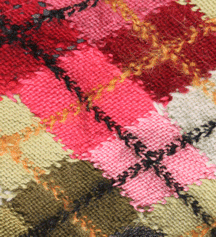
This colorful vest is a seamless argyle, too. I show the sides, so you can see there are no seams. And here’s what the inside looks like.
And October 2007, I’ll be teaching ‘Seamless Argyle Socks’ at Stitches East in Baltimore! Hurray! It’s a six-hour class, where we will complete a seamless argyle ankle sock out of worsted (medium/4) weight yarn. Then you go home and make the second sock for practice.
Hope to see some of you at Stitches!


