Moonglows and Goofies
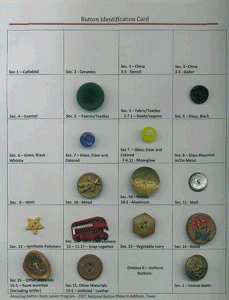
After the post about the National Button Society Convention, Woolwinder asked for pictures of moonglow and goofy buttons. Thanks to Peggy Ann Osborne’s book Button Button, I can tell you more about them than I could a few weeks ago.

Moonglows are glass buttons made in West Germany in the 1950s and 60s. They have a shimmery glass body, covered with a thin layer of clear glass. All moonglows have this shimmery, cat’s-eye finish in common, otherwise they might be different shapes and sizes or have different trims or other embellishment.
Goofies are sets of fun, plastic, realistic buttons. Sometimes they come in sets with a theme, like sea-life, with a sea-star, anemone, fish, sea-horse, and shell. Buttonarium has lots of examples of sets of goofies. In the photo here, the blue steering wheel was Eva’s goofy—it might have been part of a ship-themed set.

The others are modern realistic plastic buttons, but they wouldn’t be called goofies—they’re too new. A real goofy would be from the 1930s, ’40s, or ’50s.
The button card is one that Eva made as part of the Amazing Button Race, which kept her and several other kids occupied during the button convention. I am so impressed at how well the National Button Society treats its junior members.
Tree House Knitting

These breezy mornings are good for knitting in the tree house, while Ella plays with kittens or organizes parties with her imaginary friends. Today I was hurriedly knitting another seamless argyle, so I could help Linda Urban celebrate the publication of her book, A Crooked Kind of Perfect. The official publication date is September 1 (tomorrow!), which is also the closing date of the contest.
The rules include posting a photo of sock-clad feet (yours or someone else’s). Knitters and crocheters, this is your chance to show off your handmade socks AND to win a book and more, if not for yourself, then for some deserving kid you know.

Did I mention kittens? Ah yes. A couple of months ago, a hungry mama cat with six kittens chose to live with our family. Our four established cats were not amused. Today, at kitty-breakfast, we were joined by a seventh kitten. Huh? I don’t know where it came from.
So I am running a contest, too! Here’s how to win: all you have to do is want a kitten of your own, and live within reasonable driving distance of our home in northwest Central Texas. Okay, I’ll be waiting on pins and knitting needles for the many entries sure to come pouring in!
Swatching Noro
The Dallas Handknitters Guild meets Tuesday evening, September 4, and the speaker is going to be me! I so enjoy speaking to that group of people. The topic for the evening is Very Variegated, which is about how to use multicolor yarn to its best advantage.
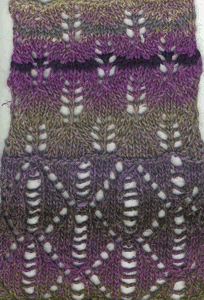
In preparation for the discussion on Tuesday night, I have been swatching with this Noro yarn called ‘the world of nature,’ on size 8 (US) needles. I bought the yarn a couple of Christmases ago, so it’s about time!
The stitch patterns are Fern or Leaf-Patterned Lace from Barbara Walker’s A Treasury of Knitting Patterns, (top), and Laddered Diamonds from Walker’s Charted Knitting Designs (bottom).
I thought the dark purple and tweedy gray would be good color partners for the Noro multicolor. You can see them toward the top of the swatch The dark purple may be too much of a contrast, but the gray doesn’t look too bad. Mostly I wanted to add interest to the knitted fabric, and to stretch the Noro a little further.
I tried hard to think of a play on words to use for the title of this post. Nothing. But imagine this: You’re standing outside the yarn shop, when you hear the sound of galloping hooves. The rider is a masked woman, her multicolor knitted cape streaming behind her. She pulls up short at the yarn shop, the cape swirls around her as the horse turns to face you. The rider takes a long knitting needle from the scabbard at her side. She scratches three lines on the yarn store wall, and then spurs her horse away. You study the scratches in the paint. It looks like the letter ‘N.’ It’s the
Mark of Noro!
A Cure for Second Sock Syndrome
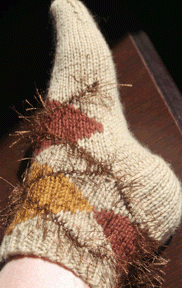
While at the Highlights Foundation Writers Conference last month, I met a lady named MJ who purposefully and successfully wears mismatched socks. She has some fabulous socks, too. And MJ unwittingly solved a problem for many knitters—the second sock syndrome, where you finish one sock of a pair, and then you don’t really feel like knitting the other one. I think it’s a been there/done that sort of thing.

Eva wore mismatched socks on purpose through about fourth grade, when she quit wearing socks pretty much altogether, much to our consternation. When she saw me working on this little seamless argyle number with Fun Fur cross-hatches, she said, “Mom, can I wear those when you’re through with them?”
“What do you mean, ‘them?'” I said, more or less. “There’s only going to be one, because this is a sample for my seamless argyle class.”
So if she ever wants to wear it, she’ll have to go back to her old ways, the MJ way, and wear it with the other sample sock I’m making in greens and yellow, with orange cross-hatches.
The great thing about knitting these samples is that I think I have made an improvement on my original seamless argyle sock. Hurrah! If you signed up for my Seamless Argyle workshop at Stitches East, you’ll be the first to knit the new, improved seamless argyle.
National Button Society Convention

Eva and I set off for Addison, Texas, last week to find out what the National Button Society Show was all about. Eva joined the other junior members at ten o’clock on Thursday morning to hear the rules of the Amazing Button Race. She sought me out at lunchtime, tired and hungry from a morning of figuring out clues and rushing around the showroom floor. She was so busy that I had time to look at more buttons than I’ve ever seen in one place.

Most of the vendors had buttons on cards, filed by the material the buttons were made of, or the subject of the button. The highest price I saw was $1,400, for an old and beautiful enamel button from France. The least expensive buttons were in poke boxes for 25 cents. A poke box has loose buttons in it, and customers can poke around in hopes of finding just what they want. One of the photos shows a poke box basket made of buttons! We might try to make one like that.

I loved looking at the button competitions. Buttons were attached to stiff paper and grouped into many divisions, according to button materials, manufacturing methods, and pictorial themes. Judges wrote comments on each entry. Sometimes they left the dreaded ‘measle,’ which is a sticky dot, marking a button that does not belong in the tray.

A measled button usually means that the person misidentified the button. In a collection of plastic buttons that were meant to mimic other materials, an entrant labeled one button ‘horn.’ The judge measled the button and wrote, “The measled button really is horn,” not just plastic masquerading as horn.
After two days, Eva had finished the Amazing Button Race, and as a consequence, knew more about buttons than I did! “Oh Mom, look,” she said very casually, “it looks like I got a vegetable ivory button in this bag. And here’s a goofy. Hey, I got a moonglow! Mom, don’t you just love moonglows?”
And a moonglow is… ?
The National Button Society has a great program for juniors. The membership fee for juniors is $2.00, and they receive all of the lovely society journals, just like a grown-up member. And the junior registration fee for the convention is $0. That’s right—it’s free. The lady who organized the Amazing Button Race said, “These kids are the button collectors of the future, and we want to encourage them.”
This old box was on display. It says, “Hand made X-L-NT Crochet Buttons Very Stylish Nicely Assorted.” Old crochet buttons are collectible, too.

The Yarn Barn of San Antonio

We tagged along with my mom to the German Texan Heritage Society meeting last weekend. The girls and I took a couple of hours to shop at the venerable Yarn Barn of San Antonio, at 4300 McCullough.
The Yarn Barn has an impressive selection of needlework books, old and new. The owner, Bobbi, showed me some yellowed British volumes that were humbly dedicated to Her Majesty, Queen Victoria. We are spoiled these days with beautiful photography, color, and layout, but those old books are packed full of information for the person who is willing to read lots of text.

Françoise Tellier-Loumagne, who has taught knitting and textile design for over thirty years, wrote The Art of Knitting: Inspirational Stitches, Textures and Surfaces, for the many knitters, including her students, who want to explore the enormous versatility of knitting.

It is heavy on pictures, which show knitted fabrics next to photos from nature. Sometimes the knitted fabrics are incorporated into the natural setting, like these knit-covered stones among real stones. The right combination of stitches and yarns look like the surf, or like leafless stalks rising out of the snow. Breathtaking!
The author includes a few diagrams and notes—just enough to get you going in the right direction if you want to reproduce some of the textures and stitches. It’s a book that expects a lot from the reader, because you have to find your own uses for these beautiful textiles.
My First Craft Book

In 1949, my grandmother gave my mother a book for her birthday. It was the first craft book I ever saw as a kid. The title is Gestaltende Hände, ein Werkbuch für Mädchen, by Hildegard Fochs. That means Forming, Shaping, Modeling, Designing or maybe Creative Hands, a Workbook for Girls.

It’s a general crafts book, with leatherwork, bookbinding, weaving, woodworking, embroidery, doll house furniture making, and of course knitting and crocheting. It even shows how to make your own cookie-cutters.
Since I learned to knit at a young age, I appreciated projects like the bird motif sweater, because it was so complex.
As a grown-up knitter, the striped sweater caught my eye. The caption says it’s a pullover done in different stitches and colors, without a pattern (ohne Schnitt), and knitted in one piece. Nowadays the text gives numbers of stitches to cast on, and how many to increase for the sleeve shaping and decrease for the raglan shaping, so I’m not sure if I’m translating the ‘ohne Schnitt’ correctly. Mom, any advice on this?
Looking at the diagram below the photo, I (as a grown-up, experienced knitter) assumed that it was knitted from the neck down, and you could try it on as you went, which is why you wouldn’t need a pattern. But in fact, the instructions have the knitter start the four pieces at the ribbing, and knit up to the underarm, then join the pieces and knit as one, decreasing for the raglan shaping up to the neck. Only the sleeves and sides are seamed.
Now, we think nothing of starting at the neck and knitting down to the armholes, then knitting the body and sleeves circularly, so we have no seams at all. Ideas about knitting and garment construction have evolved over many years.
Here’s my favorite part about the striped sweater instructions. I love it because the author shows confidence in her readers: “For the stripe pattern, we don’t want to lay down any strict rules. Naturally, one can rearrange the stripes and knit them however one wants to.” Hurray for no strict rules!
I’ll end with this photo from the book of lanterns made of stiff black paper and tissue paper. When you put a candle inside, they glow like stained glass.

Last Look at Chautauqua 2007

Chautauqua has the most Victorian-style gingerbread of anyplace I’ve ever been! Some of the houses look like they’ve been trimmed with lace. In fact, some of the pretty trims had me wishing for my crochet hook and some yarn. I was sure they would make good crochet laces.


For all the air of the past in Chautauqua, great new ideas are still proposed and discussed there. It was an appropriate setting for our Highlights Foundation Writers Conference, where many new ideas were born. The teachers gave us a good mix of inspiration and step-by-step instruction.


In that week of inspiring and instructional words, my favorite ones were spoken by Bruce Coville, author of many fantastic and magical books for kids:
People who have dreams can change things.
That’s why people who have dreams are dangerous.
And that’s why it is our job to give children dreams.

Yarn (or Yarns?) at Chautauqua

I’ve always loved that a “yarn” can be a story, as well as something you can knit or crochet with. Some people even take the connection further and say “she spun an outlandish yarn” to mean “she told an outlandish story.” Isn’t it great that it could also mean that she’s sitting at the spinning wheel, making some kind of cool eyelash, slub, sparkle yarn? Or both!?
So it seems spiritually correct to seek yarn (to knit with) at a conference of yarn-spinners (story-tellers). That is what I did. The Summer Gallery that advertised luxury yarns (see a couple of posts ago), has spun off its yarn business (how about that one, Alissa?) to a little store called Art Fibers, just off the square at Chautauqua.

Art Fibers is a small store, but it has a big selection of yarn. I was tempted by some kettle-dyed, golden/yellow yarn to use with an ultramarine blue from the same company. But the yarn that drew me in, that got me tangled in its plot, was this happy yarn from Cherry Tree Hill. (Twister, 75% merino, 25% superwash, colorway “Sugar Maple”) It was so cheerful, I had to say yes. Let’s just say it may foreshadow a future project.
Back from Chautauqua

In the 19th century, most Americans left school after the fourth grade. The founder of the Chautauqua Literary and Science Circle knew that many of those Americans wanted to learn more. Most could not afford college, so he developed a course of reading that would challenge them to think broadly.

Upon graduation, each CLSC class commissioned a banner to carry in an annual parade, and a mosaic to be installed at the Hall of Philosophy, an outdoor lecture theater. Each mosaic has the year and the theme of the class, like the one above.

Eventually they ran out of space for the mosaics, but there are over fifty of them. Here are a few. They are mostly done in stone. You can see how the motifs have an outline of one row of the background color. That’s a classical technique that emphasizes the motif and separates it from the background.

I’m back from the Highlights Foundation Writers Conference, but the people, the learning, and the strange and wonderful Chautauqua Institute will stay with me for a long time.


