Craft: Magazine is Good

My first subscription issue of Craft: arrived, and I was impressed! Its subtitle is “transforming traditional crafts,” which it does right there on the cover, with the completely silly and fun knitted Crime Scene Scarf.
Wide-ranging projects include woodworking, metal-working (making a copper button), knitting a rug with hay-baling twine, sewing car seat covers, and recycling sweaters. A long article on natural dyeing fit right in with a lady who makes costumes for hula-hoop performances, including her own. A doggie pirate costume (how-to included) followed a piece about people who dress in their favorite anime characters.
It’s a good-looking, hefty (176 pages), small format (6-5/8″ by 9-3/8″) magazine with an eclectic mix of articles and projects. I’m glad to report that men are well-represented as subjects of articles as well as authors.
The whole magazine has what I would call an urban craft sensibility: the fearless do-it-yourself ethic (which means you do it yourself, even if it’s something difficult and you need special tools and you have to learn new skills); AND a strong emphasis on recycling.
That do-it-yourself/recycling philosophy has been around a long time, in people of many ages and lifestyles. Craft: celebrates those people and their work.
Crocheted Pansies to Edge a Cape

I’ve been crocheting pansies with hand-dyed ‘Single Sport’ from Plain & Fancy Sheep & Wool Co. It is from the company’s booth at last year’s Wool Festival at Taos, which was, well, about a year ago. I’m crocheting a capelet from the solid lilac color, that is also at the center of the pansies. The pansies will be around the bottom edge of the capelet.
I hope to finish the project before the next Taos Wool Festival, so I can show it to Ken and Grayce Aggen, the owners of the Plain & Fancy Sheep & Wool Co.
In case you’re in the area, the Taos Wool Festival is two weeks from this weekend, at Kit Carson Park in Taos, New Mexico. I’ll be there, teaching workshops, from Wednesday, October 3, through Saturday, October 6. I’m doing Slip Stitch Color Knitting (a long version that includes mosaic or ‘dotty’ knitting), Polymer Clay Button Boutique: Part 2, Beginning Crochet, and Two-Handed Stranded Knitting.
And after that, it’s off to Stitches East in Baltimore! This is the first time since we moved back to the US, and since Ella was born (both happened the same year), that I’ve had such a busy teaching schedule. Woo hoo!
Eva’s Crocheted Scarf

Hip to Crochet, a book by Judith L. Swartz, has a zig-zag scarf in it, very similar to this one. Eva was greatly inspired by the book and the scarf, but unfortunately, the copy we saw at Twisted Yarns (Spring, TX) was the store copy.
We worked out our own version of the zig-zag scarf. Eva went to work, using Brown Sheep Company’s Lambs Pride Bulky, and regular Lambs Pride, held double. It used a surprising amount of yarn, and she ran out of the turquoise before she finished.
Several months later, when we went to the Yarn Barn of San Antonio, we bought enough yarn to finish the scarf. Bobbie had the book in stock, so we got that, too. (See post of August 13 2007.)
Eva finished the scarf and learned how to block it. I’m so proud of my crocheting daughter!
Knitting without a Pattern

On August 7th, I talked about the first craft book I ever knew, which belongs to my mother. I posted a picture of a striped sweater from the book. The author wrote that the sweater could be knitted without a pattern (ohne Schnitt), but then gave detailed instructions for making it. My mom explained:
This sweater is made “ohne Schnitt.” This means that instructions are given for every step of the way, such as how many stiches to increase, how many to decrease and how to do the slit in the front and the collar. This is different from the way knitted garments used to be presented in craft magazines. You found a design you liked, looked for the pattern in the pattern page, copied it on butcher paper, checked your measurements against it, made corrections (enlarging or reducing) before cutting out the pattern. Then you cast on and started knitting. If your stitches didn’t fit the “Schnitt”, you started over again. I don’t ever remember a gauge, etc. When you had to enlarge or reduce, you wrote this one the pattern, so that you remembered what to do on the other side. I remember knitting at least eight sweaters in my teenage years. They fit well and I loved them. When I learned to sew, we had to make our patterns from our own measurements.
So those teenage girls learned to make slopers!
The shawl is another project from the book, which my mom made as a girl.
Moonglows and Goofies
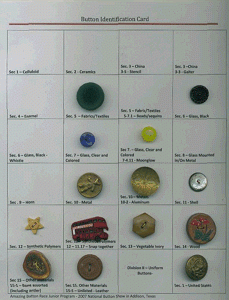
After the post about the National Button Society Convention, Woolwinder asked for pictures of moonglow and goofy buttons. Thanks to Peggy Ann Osborne’s book Button Button, I can tell you more about them than I could a few weeks ago.

Moonglows are glass buttons made in West Germany in the 1950s and 60s. They have a shimmery glass body, covered with a thin layer of clear glass. All moonglows have this shimmery, cat’s-eye finish in common, otherwise they might be different shapes and sizes or have different trims or other embellishment.
Goofies are sets of fun, plastic, realistic buttons. Sometimes they come in sets with a theme, like sea-life, with a sea-star, anemone, fish, sea-horse, and shell. Buttonarium has lots of examples of sets of goofies. In the photo here, the blue steering wheel was Eva’s goofy—it might have been part of a ship-themed set.

The others are modern realistic plastic buttons, but they wouldn’t be called goofies—they’re too new. A real goofy would be from the 1930s, ’40s, or ’50s.
The button card is one that Eva made as part of the Amazing Button Race, which kept her and several other kids occupied during the button convention. I am so impressed at how well the National Button Society treats its junior members.
Tree House Knitting

These breezy mornings are good for knitting in the tree house, while Ella plays with kittens or organizes parties with her imaginary friends. Today I was hurriedly knitting another seamless argyle, so I could help Linda Urban celebrate the publication of her book, A Crooked Kind of Perfect. The official publication date is September 1 (tomorrow!), which is also the closing date of the contest.
The rules include posting a photo of sock-clad feet (yours or someone else’s). Knitters and crocheters, this is your chance to show off your handmade socks AND to win a book and more, if not for yourself, then for some deserving kid you know.

Did I mention kittens? Ah yes. A couple of months ago, a hungry mama cat with six kittens chose to live with our family. Our four established cats were not amused. Today, at kitty-breakfast, we were joined by a seventh kitten. Huh? I don’t know where it came from.
So I am running a contest, too! Here’s how to win: all you have to do is want a kitten of your own, and live within reasonable driving distance of our home in northwest Central Texas. Okay, I’ll be waiting on pins and knitting needles for the many entries sure to come pouring in!
Swatching Noro
The Dallas Handknitters Guild meets Tuesday evening, September 4, and the speaker is going to be me! I so enjoy speaking to that group of people. The topic for the evening is Very Variegated, which is about how to use multicolor yarn to its best advantage.
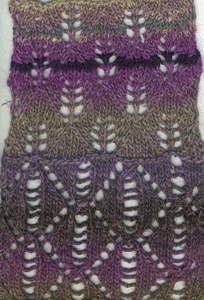
In preparation for the discussion on Tuesday night, I have been swatching with this Noro yarn called ‘the world of nature,’ on size 8 (US) needles. I bought the yarn a couple of Christmases ago, so it’s about time!
The stitch patterns are Fern or Leaf-Patterned Lace from Barbara Walker’s A Treasury of Knitting Patterns, (top), and Laddered Diamonds from Walker’s Charted Knitting Designs (bottom).
I thought the dark purple and tweedy gray would be good color partners for the Noro multicolor. You can see them toward the top of the swatch The dark purple may be too much of a contrast, but the gray doesn’t look too bad. Mostly I wanted to add interest to the knitted fabric, and to stretch the Noro a little further.
I tried hard to think of a play on words to use for the title of this post. Nothing. But imagine this: You’re standing outside the yarn shop, when you hear the sound of galloping hooves. The rider is a masked woman, her multicolor knitted cape streaming behind her. She pulls up short at the yarn shop, the cape swirls around her as the horse turns to face you. The rider takes a long knitting needle from the scabbard at her side. She scratches three lines on the yarn store wall, and then spurs her horse away. You study the scratches in the paint. It looks like the letter ‘N.’ It’s the
Mark of Noro!
A Cure for Second Sock Syndrome
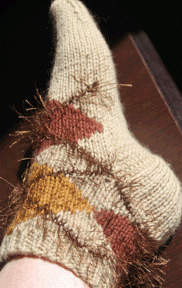
While at the Highlights Foundation Writers Conference last month, I met a lady named MJ who purposefully and successfully wears mismatched socks. She has some fabulous socks, too. And MJ unwittingly solved a problem for many knitters—the second sock syndrome, where you finish one sock of a pair, and then you don’t really feel like knitting the other one. I think it’s a been there/done that sort of thing.

Eva wore mismatched socks on purpose through about fourth grade, when she quit wearing socks pretty much altogether, much to our consternation. When she saw me working on this little seamless argyle number with Fun Fur cross-hatches, she said, “Mom, can I wear those when you’re through with them?”
“What do you mean, ‘them?'” I said, more or less. “There’s only going to be one, because this is a sample for my seamless argyle class.”
So if she ever wants to wear it, she’ll have to go back to her old ways, the MJ way, and wear it with the other sample sock I’m making in greens and yellow, with orange cross-hatches.
The great thing about knitting these samples is that I think I have made an improvement on my original seamless argyle sock. Hurrah! If you signed up for my Seamless Argyle workshop at Stitches East, you’ll be the first to knit the new, improved seamless argyle.
National Button Society Convention

Eva and I set off for Addison, Texas, last week to find out what the National Button Society Show was all about. Eva joined the other junior members at ten o’clock on Thursday morning to hear the rules of the Amazing Button Race. She sought me out at lunchtime, tired and hungry from a morning of figuring out clues and rushing around the showroom floor. She was so busy that I had time to look at more buttons than I’ve ever seen in one place.

Most of the vendors had buttons on cards, filed by the material the buttons were made of, or the subject of the button. The highest price I saw was $1,400, for an old and beautiful enamel button from France. The least expensive buttons were in poke boxes for 25 cents. A poke box has loose buttons in it, and customers can poke around in hopes of finding just what they want. One of the photos shows a poke box basket made of buttons! We might try to make one like that.

I loved looking at the button competitions. Buttons were attached to stiff paper and grouped into many divisions, according to button materials, manufacturing methods, and pictorial themes. Judges wrote comments on each entry. Sometimes they left the dreaded ‘measle,’ which is a sticky dot, marking a button that does not belong in the tray.

A measled button usually means that the person misidentified the button. In a collection of plastic buttons that were meant to mimic other materials, an entrant labeled one button ‘horn.’ The judge measled the button and wrote, “The measled button really is horn,” not just plastic masquerading as horn.
After two days, Eva had finished the Amazing Button Race, and as a consequence, knew more about buttons than I did! “Oh Mom, look,” she said very casually, “it looks like I got a vegetable ivory button in this bag. And here’s a goofy. Hey, I got a moonglow! Mom, don’t you just love moonglows?”
And a moonglow is… ?
The National Button Society has a great program for juniors. The membership fee for juniors is $2.00, and they receive all of the lovely society journals, just like a grown-up member. And the junior registration fee for the convention is $0. That’s right—it’s free. The lady who organized the Amazing Button Race said, “These kids are the button collectors of the future, and we want to encourage them.”
This old box was on display. It says, “Hand made X-L-NT Crochet Buttons Very Stylish Nicely Assorted.” Old crochet buttons are collectible, too.

The Yarn Barn of San Antonio

We tagged along with my mom to the German Texan Heritage Society meeting last weekend. The girls and I took a couple of hours to shop at the venerable Yarn Barn of San Antonio, at 4300 McCullough.
The Yarn Barn has an impressive selection of needlework books, old and new. The owner, Bobbi, showed me some yellowed British volumes that were humbly dedicated to Her Majesty, Queen Victoria. We are spoiled these days with beautiful photography, color, and layout, but those old books are packed full of information for the person who is willing to read lots of text.

Françoise Tellier-Loumagne, who has taught knitting and textile design for over thirty years, wrote The Art of Knitting: Inspirational Stitches, Textures and Surfaces, for the many knitters, including her students, who want to explore the enormous versatility of knitting.

It is heavy on pictures, which show knitted fabrics next to photos from nature. Sometimes the knitted fabrics are incorporated into the natural setting, like these knit-covered stones among real stones. The right combination of stitches and yarns look like the surf, or like leafless stalks rising out of the snow. Breathtaking!
The author includes a few diagrams and notes—just enough to get you going in the right direction if you want to reproduce some of the textures and stitches. It’s a book that expects a lot from the reader, because you have to find your own uses for these beautiful textiles.


