
Sweater and Angel Progress

While the Dallas Cowboys played on Sunday, I worked on Ella’s cardigan sleeve. I used the usual method of decreasing one stitch each side, every fourth row, from the beginning of the armhole shaping down to the wrist. That proportion works for almost every long-sleeved sweater I’ve ever made.
“Ella, let’s try your sweater on,” I said, after the game. Oops! Her arms don’t decrease one stitch each side, every fourth row! They stay the same distance around, down to her elbow. So I had to pull out about three inches of knitting, and adjust the decreases accordingly.
The beauty of knitting from the top down, is that you can try the garment on before you finish it. Thank goodness!

I am trying to finish the components of the felt angel ornaments, so that all I have to do each week is put them together. The wings are all finished now. Aren’t they cute?! The embroidery and sequin-sewing seem fiddly, but the result is so nice that I don’t mind at all.
Band Crafts and Angel Count

We went to Hamilton on Saturday night, to hear Eva play in the All-District Middle School Concert Band. They sounded great! Eva looked great, too. She talked me into making her this green skirt. She was going to try sewing it about a year ago, but got distracted by other stuff. It was already mostly cut out, and all I had to do was sew it. Eva and her blond hair look fabulous in green.

She’s pleased to play the oldest clarinet in the whole band—over thirty-five years old! It’s the one I played in junior high and high school. The handle was beginning to fall apart, so we repaired it with a scrap of beautiful leather, courtesy of Wendy Allen Saddlery.
Angel count: three done and four to go! When one is done, I hang it from a tack in our kitchen. Ella usually notices it right away. We are hanging them on our ficus tree, which is inside for the winter.

Angel Hair

The hair of these little gals is what finally put me over the edge, and caused me to put them away, unfinished, for several years. It never seemed to work out right.
For one thing, I could never get it to adequately cover the blue dotted lines on the face, which mark the hairline. The only reason you can’t see them now is that I carefully fixed the hair before scanning the heads. I think glue may be in order.
Just thinking of the hair made me feel queasy when I recently got them out to finish. “Get it over with!” my inner me said. So I gritted my teeth and finished five heads full of angel hair this week.
It makes a big difference to just be able to pick up the head and plop it onto the body, without having to worry about embroidering smiles or sewing strands of hair in place. I feel like I’m well on the way to finishing the project in time for Christmas, as planned.
A Pink Project and an Angel Count

Last spring, when I was consumed by crocheted flowers, four-year-old Ella looked at me soulfully and said, “Mama, when you’re done with your book, would you knit me a pink and purple sweater?”
How could I resist such sweetness, not to mention the big brown eyes? Well, I couldn’t.
We ordered Knit Picks’ Merino Style. The pink, called “Petal,” is just lovely. Here it is, down to the back armhole shaping. The stitch is “Wheat Ear Rib,” one of my favorites from Barbara Walker’s A Treasury of Knitting Patterns. I spaced the ribs out a little further than she did.

My strategy is to knit from the shoulders down, so I can lengthen the sleeves and hem if necessary. Ella is a tall, tall girl. She’s wearing clothes that Eva wore when she was seven and eight years old. Anyway, the ribs will go straight down from the shoulder to just under the armhole. Then I will increase between the ribs, so the rest of the sweater flares out. It will look like this.
Angel count: two done, five to go.

Felt Angel Ornaments

I just love sparkly Christmas ornaments, and it’s so much fun to make them from kits. Yes, I love having all the supplies already gathered in one place, and to let someone else do all the designing and decision-making, for a change. I get my kits from Herrschners.
These are parts of angel ornaments from a Bucilla kit I started several years ago. It had a dozen angels, all blond and brown-eyed. Surely not all angels are blond, so I gathered wool for some different hair colors, including gray. And I varied the eye color, too. The designs on the dresses were too repetitive, so I decided to use different beads and stuff to decorate them. So much for letting someone else make all the design decisions.
Five angels have been done for several years. The last seven have been in pieces ever since. Now that my big, secret project is done, I’m going to finish these little gals. If I finish one angel a week, and they should all be done before Christmas.
Secret Project Revealed, At Last

A few times over the last year, I mentioned a big, secret project I was working on. I couldn’t say what it was at the time. However, since you can already order it from amazon.com, I can now reveal the details.
Yep, I wrote a book! It is called Crochet Bouquet. Lark Books will release it in May 2008. The book has lots of crocheted flower and leaf designs with step-by-step instructions for making them. You’ll see how to use the flowers to decorate clothing and accessories. I give practical tips for choosing yarns, and several finishing techniques that you can apply to all your crochet projects.
A little over a year ago, I started designing and crocheting the flowers, leaves, and projects for the book. I badly wanted to post about it, but as the folks at Lark told me, it’s better not to show too much of a new book before it comes out. So I restrained myself, and worked on flower designs instead. Oh, there are a few glimpses of the flower designs, here and there, but not enough to spoil the surprise, I hope.
After I turned in all the samples and instructions in May, the editorial and art teams at Lark Books got to work. Lark takes care of all the photography, illustrations, and layout, in addition to the editing. They produced a very happy and pretty book. I love how it looks.
We all sighed with relief, when Crochet Bouquet went to the printer on October 16. Now all we have to do is wait—and start on another big, secret project!
Gail’s Buttons

Walking the Stitches East market last week was like being in a beautiful dream of yarns and books and tools. Several farms and cottage industries had booths, with yarn spun from their flocks, and often hand-dyed. I saw loopy bouclé mohair galore, which can only mean that it is on its way back into fashion.
Then I rounded a corner, and one booth shone like a beacon. I went toward the light. I found heavenly buttons–colorful, sparkly, shiny, crazy buttons. They were all hand-made by Gail Hughes, at her studio in Kentucky.
Gail saw the black and pink poncho draped over my arm. We agreed that we are on the same bold color wavelength. “I can’t seem to get these buttons loud enough,” she said, pointing to a rack of wild polka-dotted buttons.
I bought two Crazy Cards (right and left in the photo), which feature more than one kind of button on a card. Four-year-old Ella already claimed the pink buttons from the card on the right. “I’m going to string them, Mama,” she said. Eva loved the green one, as I knew she would.
The black and glittery buttons (middle) to put on a brown sweater I hope to knit this fall.
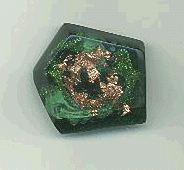
All of Gail’s buttons are made of epoxy resin. Many of them are joyfully colorful. Others have scraps of iridescent paper, sparkly material, beads, and glitter embedded in them. I loved this one with its shreds of copper and green sparkly swirls. It measures about 1½ x 1¾ inches.
Gail normally sells to shop owners at wholesale shows. She’ll be back at Stitches East next year (November 6-9, 2008). If you can’t wait until then to buy some of Gail’s buttons, talk to your local yarn shop about ordering a line of buttons from Gail.
Good Morning Taos, Good Night Baltimore

What a great way to start the morning! I was on the way to breakfast in Taos last week, when I saw this gorgeous sight. I think a lot of Taos mornings are like this. My workshops, Beginning Crochet and Two-Handed Stranded Knitting went well, and the Wool Festival was good as usual.

Friday night we ate supper with Donna Druchunas http://www.sheeptoshawl.com and her husband. Donna wrote Knitted Rugs, which was published by Lark Books a few years ago. She says in her book (and in person) that a rug I made was her inspiration to write the book. She saw it in “Knitting Underfoot,” an article I wrote for INKnitters magazine a number of years ago. Hurray! It’s very satisfying to be an inspiration.
We also met Joanne Seiff and her husband, Jeff. Joanne is writing a book about wool festivals. She and Jeff have been traveling all over the country to photograph and write about them. Watch for her book in the next year or so. Jeff is an entomologist, and he gave Eva some good moth-collecting tips.

Saturday was sunny and warm—perfect for a Wool Festival. The dyed mohair locks are among our favorites. They’re so pretty and full of potential. Eva visited with this angora bunny. He had several bunny buddies with him. “Mom, all those rabbits are named ‘Buck,'” Eva said. Hmmm, I wonder if all the girl bunnies were named ‘Doe’? 🙂


Cadillac Ranch was a good stopping place on our long drive home. It’s right outside Amarillo. I loved the colors in this graffiti. Graffiti can be beautiful. Charles read somewhere that the spray paint may be keeping those old cars from falling apart.

And then we. . .hey, wait a minute. This doesn’t look like Taos or Texas! Nope, it’s downtown Baltimore, where I am now. Stitches East started today, and soon it will be time for the teacher and vendor banquet. Then we get a preview of the market. Oh boy!
Great Knitters at Stitches East ’07

Look at these great seamless argyle socks! They are the work of the diligent, intrepid advanced knitters in my Seamless Argyle Socks workshop at Stitches East. The class takes a lot of concentration. They stuck with it and made progress. I’m proud of them!
It was fun to hear them say things like “Wow, you wonder how it’s going to work and then it does and it’s really cool!” I knew just what they meant.
I don’t know about them, but I needed a hot bath and a whole evening of reading a detective mystery with my legs propped up on a pillow, in order to recover. The book was a Nero Wolfe mystery, by Rex Stout.
Here are some of the workshop samples from Dotty Knits, which is my version of mosaic knitting. See how the hearts are dotty? This was another group of good knitters and nice people! I even gained a new insight on charting mosaic designs, thanks to Robin. Teaching is a great way to learn.
Seamless Argyle Socks and Dotty Knits are both offered at Stitches West, February 21-24, 2008, at the Santa Clara Convention Center, Santa Clara, California. More details at http://www.knittinguniverse.com/events.

Taos Workshops Are Underway

We arrived in Taos, New Mexico, Tuesday evening, after three days of leisurely driving through Texas and Northern New Mexico. We crossed plains, grasslands with lonely mountains, and finally mountains. It is a beautiful drive.
I taught Slip Stitch Color Knitting Wednesday, and the ladies in my class were relaxed and willing to try something new. We had a good time together.

At lunch, some of us slipped off to the legendary LaLana Wools. La Lana specializes in dyeing custom mill-spun yarns. There are a few handspuns there, too. Here’s a tree of Phat Silk, a merino and silk blend. Look at the gorgeous colors! And here’s a table covered with skeins of Bombyx Silk.
The shop has lots of patterns designed for use with their yarns. You should go, if you can.
Here are Crazy Polymer Patchwork Buttons that we made in class today.


