
Nana Sadie Rose and Her Fabulous Project Bags

We’ve all made friends online. Every now and then, on a very happy day, we get to meet them in person!
Years ago, I joined a Yahoo group of knitters. Among them was Nana Sadie Rose. At the time she was knitting lace things and learning the wonders of the lace life-line. She also designed and sewed the most lovely and useful tote bags and project bags.

Naturally, because Nana Sadie Rose herself knits, her bags are especially good for knitters and crocheters. She makes them in various sizes for different kinds of projects and she makes sure they have plenty of pockets for tools and needles and such.
I have wanted one of those bags for a long, long time. Finally, at the Knit & Crochet Show in September, my wish came true! Nana Sadie Rose was there in person selling all kinds of bags. One of them had a button custom-made by…me!
The best part of it all was that I met Nana Sadie Rose, in person, finally. She is as lovely as her name.

On her website, http://www.nanasadierose.com/, she lists the shows where she has a booth. You can also order online from her stock OR she will make a special bag with fabrics that you choose from her online fabric partners. Oh, my gosh. You’ll be sighing over all the beautiful fabric choices for hours.
My owl bag (Posy style) was the cutest in the whole booth (except for the skeleton bag, perhaps). Currently, it has socks-in-progress inside.
Brown Seveness Cardigan is Done!

After two years and two months in the making, my brown seveness cardigan is finished! (Actually I thought it was longer than that. Thank goodness we have blog archives to aid our memory.)
Here’s the best part: our weather was cold enough yesterday to wear it!
I had eight of Gail Hughes’s lovely buttons, but only seven buttonholes. I felt sad for the eighth button. It would be lonely in a drawer, away from its siblings. So I sewed it to the button band, too. All better!
Last Minute Sunflower CAL for October 2011

After record-breaking heat and draught this summer, our part of Texas welcomed about 5 inches of rain last month. The flowers wasted no time putting on an autumn show of color: yellow cow-pen daisies, magenta four-o’clocks, red and blue sage, and multicolor lantana.
Then, two nights ago, we came perilously close to freezing temperatures. Bloom while you can, dear flowers!

We crocheters should flower, too, whether in the last few moments before the winter here in the Northern Hemisphere, or because it is spring in the Southern Hemisphere. So for our last-minute October CAL, let’s make the Sunflower from pages 71-72 of Crochet Bouquet. Its center is Loopy, on pages 57-58.
This flower looks lush and complicated, but it isn’t! Well, it is lush, but it is not complicated. You make it in two easy pieces and sew them together.
The yellow flower begins with a double-crochet circle. Around the outside you crochet one simple petal over and over. It takes a while to crochet, but the crochet is easy.

When you’re done, the petals will probably curl. We don’t want that.
To uncurl them, hold each petal at its base, then pull the point out. Don’t be shy! They won’t break. Then grasp each petal on both sides at its widest point. Pull again.

My Sunflower is crocheted with Aunt Lydia’s No. 10 cotton thread. Here it is, above, with some of the petals pulled out by hand. Still, it needed more. I made it wet, squeezed it out, uncurled and pulled out all the petals by hand, and laid it out to dry (right).
You may want to steam block your sunflower, depending on the yarn you used. If the petals are curling stubbornly, pin them out, like Judith did here.
Center Loopy on top of the Sunflower and sew them together.
Gail Hughes Art Buttons at Quilt Festival

Gail Hughes will be selling her gorgeous buttons at the Quilt Festival, November 2 (preview night) through November 6, in Houston, Texas. She designs and manufactures them herself in the United States. Hurray!
In case you’ve missed my previous posts about Gail’s buttons, let me gush about them some more. They’re colorful. They’re all shapes and sizes. Some have glitter or other sparkles. Some are shiny, while some glow from within a matte finish that reminds me of delicious candy. I have some of her flower buttons that would be perfect for the clothing of a Dr. Seuss character. But she also has some crisply sculptural buttons that will send your mind back to the Art Deco era and Bakelite.
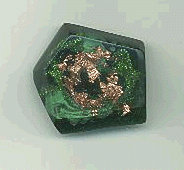
I buy Gail’s buttons because of a primitive human need to own beautiful objects. Sometimes there’s a cardigan awaiting closures. Other times I design a project around the buttons.
Experience the thrill of buttons at Quilt Festival next month!
More Buttons at the Knit & Crochet Show
Early Friday morning I made my way to the button classroom to finish baking buttons we made the day before. As the start of class came closer, familiar faces and new faces greeted me for Polymer Clay Button Boutique 2.

At nine o’clock, Jane, Susan, Mary, Diane, Mira, Rae, Ingrid, Charles, Joyce, Willett, June, Barb, Mary, Judy, and Camilla got busy mixing colors for faux turquoise buttons. We grated clay, and applied paint. We worked hard all day. The piles of buttons grew and grew. There was lots of talking and laughing.
By the end of the day, we finished the turquoise buttons, made twisty mica-shift buttons, flower millefiori buttons, and mosaic buttons. I had to take them back to my room to finish baking. Find lots more photos from our button classes here.

One of the great things about teaching is that I learn from the people in my classes. They try things I’ve never thought of, like this new way to do millefiori flower buttons by Judy and Charles.

Buttons at the Knit & Crochet Show

The fall Knit & Crochet Show in Greensboro was SO MUCH FUN! If you’ve never been to a knitting and crochet convention, you should go at least once to experience the amazing feeling of being around so many fellow yarn lovers. It will make your day, your week, your year!

Thursday morning at nine, we started our Polymer Clay Button Boutique class by making fake lapis buttons, courtesy of Sue Heaser’s recipe. Her book, The Polymer Clay Techniques Book, is the best. I recommend it.

By the end of the day, we were exhausted but happy. Everyone had piles of buttons, and we had a backlog next to the oven, waiting to be baked. Next time I’m bringing two toaster ovens.
Many, many of the buttons we made in class are on Flickr. I hope you’ll go and see them. They’re gorgeous!
Bullion Class at Knit & Crochet Show

I’m really looking forward to teaching the “Full of Bullion (Stitch, That Is)” class at the Knit & Crochet Show in Greensboro, North Carolina!
We’re going to cover the bullion stitch which is especially beloved by free-form crocheters. Then we will learn the fabulous double bullion stitch. We’ll use both bullion stitches in edging and motif patterns that I designed especially for this class. Here are a couple of them.
For information on the Knit & Crochet Show, visit http://www.knitandcrochetshow.com.

Bullion Stitch Class at Knit & Crochet Show
I’m looking forward to teaching the “Full of Bullion (Stitch, That Is)” class at the Knit & Crochet Show in Greensboro, North Carolina next week!
We’re going to cover the traditional bullion stitch, which is especially beloved among free-form crocheters. Then we will learn the fabulous double bullion stitch. We will use both bullion stitches in edging and motif patterns that I designed especially for this class. Here are a couple of them.
For information on the Knit & Crochet Show, visit http://www.knitandcrochetshow.com.
Brown Cardigan On the Move

Early this year, a fellow band mom, who is also a quilter, invited me to join a quilting group that meets once a week. “Just work on whatever you’re working on,” she said.
Now, one day a week, I get several hours of uninterrupted time to work and visit with other textile folks. It has been so much fun!
Seeing this as an opportunity to get some UFOs done, I brought the Brown Seveness Sweater to our weekly get-together. Look at it now! One more sleeve and the knitting is done. Then I have to weave in about a bajillion yarn ends, sew on these gorgeous buttons by Gail Hughes, and I’ll be set for the cold weather.

We had our doubts about ever experiencing cold weather again, after a summer of record-breaking heat. A cold front blew in yesterday and restored our hope. It’s cool and windy. Ahhhhhh.
Maybe I’ll be able to wear my sweater someday, after all—if I can get it away from our dog. His name is Firewheel.

Organize Earrings with Crocheted Flowers and Plastic Canvas

Here’s a pretty way to organize your pierced-earrings! Embellish a sheet of plastic canvas with crochet trim and crocheted flowers. Sew on a crocheted cord for hanging. Reinforce the top edge of the plastic canvas, so it won’t buckle when you hang it up. Finally, add earrings.
You will need:
- A sheet of plastic canvas, available in the needlework section of craft stores
- No. 10 crochet cotton in matching and contrasting colors (I used Aunt Lydia’s Classic No. 10 Crochet Cotton in lavender, violet, and shaded yellows for the trim, wasabi for the leaf, lavender, violet, yellow, shaded violets for the pansies)
- Crochet hook, 2.00mm (size 4 steel U.S.) or size needed to achieve a firm gauge
- Sewing thread and sewing needle
- Tapestry needle
- A crocheted flower or flowers and leaves from Crochet Bouquet, using No. 10 crochet cotton (I made two Plain Pansies and one Spiky Leaf, pages 63-64, 121-122)

Crochet around the edge of the plastic canvas:
Rnd 1: Begin anywhere along the edge of the plastic canvas. Place 1 sc in each mesh square along the sides. In each corner square, (1 sc, 3 ch, 1 sc). Needle join last sc to first sc (find step-by-step photos of needle joining here in photos E, F, and G.)
Rnd 2: Begin a new color in the ch-3 sp at any corner of rnd 1 with ** (sc, ch 3, sc), * sk 1 sc, ch 2, sc in next st; rep from * to within one st of next corner, sk 1 st, rep from ** around, ch 1, needle join to first sc of rnd.
Rnd 3: Begin a new color in the ch-3 sp at any corner of rnd 2 with * (2 hdc, ch 3, sl st in 3rd ch from hook) twice; working along the side, (2 hdc, ch 3, sl st in 3rd ch from hook) in each ch sp to next corner; rep from * around, needle join to first hdc of rnd.
Flowers and Leaves
Crochet desired flowers and leaves for embellishment.
Hanging Cord
Leaving a long tail for sewing, ch 2, sc in 2nd ch from hook, * insert hook into side of sc you just completed, draw up a lp, yo and draw through both lps on hook; rep from * until cord is about 1″(2.5cm) longer than the top edge of the plastic canvas. Fasten off, leaving a long tail for sewing.
Finishing
Weave in ends. Arrange flowers and leaves on plastic canvas. Sew in place with sewing thread, making stitches around the inner rounds of the flower, leaving the outer edges of the flowers free for a more natural look. Make sure you catch the meshes of the plastic canvas as you sew. This sounds silly, but I found this part to be challenging!

Use No. 10 cotton to sew the dowel rod to the top back of the plastic canvas. This keeps it from bowing out when you hang it up.
Sew the Hanging Cord to the top corners of the plastic canvas.
Hang fish-hook style earring from the meshes in the canvas. You can also store stud earrings on the plastic canvas, as long as the earrings don’t fall through the mesh.