
A Flower Called Antelope Horns

“They look like aliens,” said my husband, when he saw this photo, blown up to poster size. It’s a very close-up view of Antelope Horns milkweed, one of the coolest flowers I love.
We saw this particular plant on my parents’ place and I believe my daughter Ella snapped this picture with my phone. The five-petal flowerets are about half an inch across in real life, which makes their fantastic detail hard to see very well. I cropped the photo and had it printed as two 2 x 3-foot posters.

One poster was my pattern for cutting out the leaves and petals. I numbered each flower, leaf, and background piece on the poster and on a black-and-white printout before cutting.

I cut each flower into individual petals. I left the white and purple bits in place, planning to applique those onto the surface later. At this point, the important thing was to make a solidly-covered quilt top.

Before all this numbering and cutting business, I knitted the fabric for the Antelope Horns wall hanging on the Ultimate Sweater Machine. The knitting took about three hours, even with all the color and yarn changes (they are easy on the USM). I steam blocked the fabric and then stabilized it with fusible interfacing. The interfacing stops the stitches from unraveling when I cut the fabric. Also machine-sewing the patches is a lot easier when they are stabilized.

After all the individual petals were cut out, I pinned them to my knitted, stabilized fabric. I tried to line up the petals from one flower, so that they would mostly have the same striations in the knitted fabric. Time to cut out again.

Okay, here are the pieces of the poster with knitting pinned underneath. The next step is to piece them all back together.
Crochet, Science, and Our Daughters

My college sophomore daughter, Eva, was home for the holidays. We don’t have a TV, we live in the country, her friends were scattered across the state, and there’s only so much Twitter and such a person can do before petrification sets in.
“Mom, I want to crochet,” she said.
Was it my imagination, or did a choir of angels sing “Hallelujah” at that moment? It could be–her words were definitely music to my ears.
She chose some lovely Berroco Remix yarn (blended from 100% recycled fibers). I showed her the basic idea of a raglan sweater from the top down. She got to work.
With only one minor redesign and a minimum of ripping out and recrocheting, Eva completed a sweater for her stuffed kitty.
But one sweater was not enough. Eva crocheted a cell model. You can tell this is an animal cell model, because it has a cell membrane (blue). The nucleus has a pale green membrane and the red squiggles inside are genetic material. The green ovals are vacuoles and the red oval is a mitochondrion, powerhouse of the cell. The Golgi apparatus is yellow and the endoplasmic reticulum is squiggly and blue. Note that it has no bumps on it, therefore it is smooth endoplasmic reticulum.

This episode reminded me of a long, interesting, and sometimes saddening article I read in the New York Times a while ago, “Why are There Still so Few Women in Science?” Author Eileen Pollack, a novelist and creative writing professor at University of Michigan, spoke to astrophysicist Meg Urry of Yale University, who had this to say about crafting:
“I’m soldering things, and I’m thinking, Hey, I’m really good at this. I know the principles. It’s like an art. It took me years to realize I’m actually good with my hands. I have all these small-motor skills from all the years I spent sewing, knitting and designing things. We should tell young women, ‘That stuff actually prepares you for working in a lab.'”
Yes, let’s tell this to our crafting daughters and sons! It’s another of the many benefits of “sewing, knitting, and designing things.”
I laughed ruefully after reading Professor Urry’s assertion that “Women need more positive reinforcement, and men need more negative reinforcement. Men wildly overestimate their learning abilities, their earning abilities. Women say, ‘Oh, I’m not good, I won’t earn much, whatever you want to give me is O.K.'”
Why ruefully? Because when I was a biology major, oh so long ago, I was exactly the woman she was talking about.
The crocheted cell model opened doors for Eva. She emailed a photo of it to her last semester’s biology professor. A week later the professor invited her and a few other former students to lead review sessions for the same biology class this semester. No pay, but the professor promised glowing letters of recommendation.
“I think it also helped that my friend and I went to her class last Halloween, dressed up as NAD and NADH molecules,” said Eva.
Mark Your Calendars for Great Crochet

We’ll have a lot to celebrate on March 17 this year. Naturally we’ll be wearing green (or our color of choice) for St. Patrick’s Day. Then we can mosey down to the nearest newsstand for a copy of the Spring 2015 issue of Interweave Crochet.
One of my career goals has been to publish a design in Interweave Crochet. Well, this is it! My Dogwood Scarf appears in this issue. And here’s the best part: it’s on the cover!
I hope you’ll buy a copy, because it has lots more great crochet designs in it. Or better yet, subscribe. Find more information
Throwback Thursday: Cherry Picking Vest

Moths have good taste. They chose to place their offspring on my beloved cherry sweater,
which I knitted by hand from Sasha Kagan’s Big and Little Sweaters. On their way to adulthood, the baby moths nibbled more holes than I wanted to repair.
So I put the cherry sweater with an oversized red sweater that never looked good on me
anyway, and made this crazy-patchwork vest.
After machine embroidering the red sweater I stabilized the knitting with
fusible interfacing.
I cut the stabilized sweaters into patches and arranged them on a lightweight cotton foundation
cut from a commercial vest pattern. I sewed them in place.
Oh no, the patchwork didn’t look good! The bright reds, blue, and white looked too busy and choppy. What could I do?
Decorative stitching along the join lines helped a little. I tried various tricks to tone down
the stridently contrasting colors.
Finally I saw what was in front of my eyes the whole time. The vest had a circle theme (the
red cherries and the embroidery motifs). What (usually) circular item do I love and have in
droves? Buttons! To tone down the white, I added red buttons (an echo of the cherries). I made the busy pattern even busier! Much better.
If red buttons on the white areas looked good, would white buttons on the red and blue areas
be even more wonderful? I tried it out. Yes! This is one of the happiest projects I’ve ever made.
It makes me smile every time I see it.
This vest was accepted into the Small Wonders exhibition at the 2005 Spring Quilt
Festival in Chicago
Gambel Oak Leaves: A Photo Tutorial

Patricia, a crocheter who contacted me through Ravelry, asked for clarification of the instructions for the Gambel Oak Leaves on pages 21-23 of Crochet Garden. Thank you for asking, Patricia!
We’ll start with the Small Leaf (page 23). You will need the book for complete stitching instructions:

Both Gambel Oak leaves are made with long rows that comprise the lobes (always odd-numbered rows) and short rows which are the spacers between the lobes.
Here are the first two rows of the Small Leaf. Row 2 has a long turning chain, because Row 3 is a long row. Some of the sts of Row 3 are on the chain, and some are made into the sts of Row 2, as you can see from the marks on the photo.

Row 3 is finished, and includes a turning ch for Row 4.

These are the rows through Row 5.
Design Note:
Think about a ripple afghan. To make the bottom of the “V” in a ripple afghan, we decrease stitches to pull up the stitches on each side of the bottom point, to make the V. By decreasing at the center of the leaf, we’re pulling the lobes up from the bottom point of the leaf. We’re making half of a V.
Also, in Rows 1-4, the stitches toward the center of the leaf are long. Rows 5-9 have sc or sl st as the last st toward the center of the leaf. The short stitches curve the lobes around the top of the leaf to start down the other side.

After the last st of Row 9, we join to the first half of the leaf with a sl st in the base of Row 5. The base of Row 5 is the stitch in which the last st of Row 5 was made.
Then ch 1, sl st into the base of Row 4. The base of Row 4 is as close as you can get to the first ch of the turning chain at the end of Row 3 (which leads up to Row 4). The marks show the base of each row you need to stitch into.

This is what the leaf should look like at the end of Row 9, just before you turn.

For Row 10, skip the sl sts that join to the center of the leaf, and work sts as shown.

Row 11 is done, and this shows where to join in the base of Rows 3 and 2.
Design Note:
Back to the idea of a ripple afghan. To form the peak of a chevron in a ripple afghan, we increase stitches at the top. This pushes down the stitches on either side of the peak to make an upside-down V or arrow point ?.
Hold the leaf, with the top lobe pointing down. The lobes join at the top of the peak. That is why, on this side of the leaf, working from tip to base, we increase sts close to the center of the leaf. We do it to push the lobes down toward the tip of the leaf.
Think about it this way: an increase is an upside down decrease; a decrease is an upside down increase. This is a good thing to know when you’re designing your own patterns.

Row 13 is finished and joined to the base of Row 1. Now we’re ready to make the stem.

After crocheting the stem, take the yarn to the wrong side of the leaf. Read the full instructions for making the central vein, page 22.

Working up the middle of the leaf, insert the hook from front to back, yo at the back, make ch sts where the space is long, if you’re close to a joining stitch, sl st in that st. Work these ch and sl sts until you are at the base of the top lobe. Cut yarn and pull to front.

Insert the hook from wrong side to right side at the point where the yarn comes out of the leaf, but do not insert the hook in the last ch st. Yo with the cut end and pull it to the back. The last ch st will prevent the stitches from unraveling. Weave in ends.

Here’s the Large Leaf (instructions begin on page 21), worked through Row 11. The marks show the bases of the rows where the lobes are joined with sl sts.

Row 11 is joined with a sl st in the base of Row 7.

This shows where to place the sts of Row 8.

When you finish crocheting the leaves, the lobes curl into themselves, so as you block, be sure to stretch the end of each lobe to pull them out to their proper shape.
To block small pieces like this, I hold them under the water tap for a few seconds, squeeze out excess water, stretch each lobe, and finally hold a hot iron over them, barely touching the crochet. Sometimes I use a damp press cloth to protect the stitching as well as add more steam.
Perspective Daisy Table Mat Finally Finished

I enjoy getting together with family on weekends and “watching” football. Why did I put “watching” in quotes? Because I usually only look at the TV when people get excited, hoping that whatever fantastic play just happened will be shown again. Sound familiar, my fellow knitters and crocheters?
Yep, I’m usually working on some kind of project. But it can’t be too complex, because that would keep me from listening to the conversation and the commentary. So the project for this season has been Crochet Charm Lace.

Last weekend, as we watched the Texas Longhorns play football, I finished the Perspective Daisy table mat. I’m still debating whether to add more filler motifs. Before I decide, it needs to be used for a while. That way, I’ll be able to see where they are needed most.
On to the next project!

The Perspective Daisy pattern is from Crochet Garden: Bunches of Flowers, Leaves, and Other Delights. Follow the progress of the Perspective Daisy table mat project in these posts about Crochet Charm Lace.
Third Grade Art Days

I was the lucky one on October 23! My daughter Ella and I spent a busy morning with third graders at an Austin-area elementary school for Art Days. This is Ella at the beginning of the day.
Parents spent weeks organizing and preparing for Art Days, and funded the purchase of most of the supplies, and organized visits by visual artists, musicians, actors, and authors.
My work room was all ready to go with a gallon of school glue and an 8 x 10″ canvas for each student. Ella and I brought buttons, beads, sequin trims, felt, and crocheted bits and pieces. I had lots of…let’s call them crocheted beta-flowers. They were the part of the process of designing flowers for my books. I didn’t want to throw them away, so they sat on my storage shelves for years. It’s a good thing I saved them, because look what those third graders did with the supplies!


This is “Superman with a Zipper.” See the green sequin “S” for Superman?


Ella finally got to decorate her own canvas, after helping two sets of third-graders.

Third graders, hard at work.
Cute Crochet World’s Owl Makes Artistic Debut
Owls are so cute! Crocheters love them, if #crochetowls on Instagram is anything to go by, or have a look at crocheted owls on Google Images for an amazing variety of big-eyed birds.
To quote the famous sonnet writer, Elizabeth Barrett Brownyarn, “How do I crochet an owl? Let me count the ways. Oh, wow. There are lots of ways to crochet an owl!”
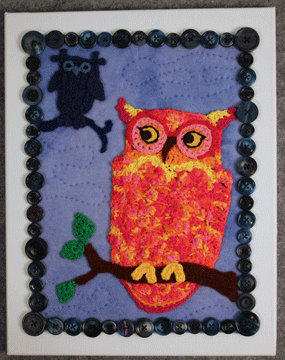
Night Owl, Bright Owl, ©2014 by Suzann Thompson,
commissioned by the friend of a bride who loves owls.
Crocheted Forget Me Not Step-By-Step

Today is National Forget-Me-Not Day! Who knew? Many thanks to Vintage Belle Broken China Jewelry, on Facebook, for bringing this to my attention! National Forget-Me-Not Day reminds us to get in touch with friends and relatives that we don’t see very often.
What better day to bring you a tutorial for the Forget Me Not flower on pages 86-87 of my book Crochet Garden? You’ll need a small amount of yellow yarn for the center, white or very light blue for Rnd 2, and sky blue for the petals. These photos and hints are meant to supplement the crochet instructions in the book.

Draw up a loop (as in photo). Now you have three loops on your hook, which is exactly what you need to finish the double crochet. Work the rest of the stitches of Rnd 2 in the front loops only of Rnd 1.

Here’s Rnd 2 all finished, with the yarn ends woven in. Do you see the stitches of Rnd 1 that have no stitches of Rnd 2 in them? We’re going to call those “free sc”s.

Rnd 3 is worked in the back loops of the stitches of Rnd 1, so you need to fold Rnd 2 to the front, completely out of the way, and insert your hook behind Rnd 2 into the back loops of Rnd 1. The first stitch of Rnd 3 goes in any “free sc” of Rnd 1.

When you’re finished with Rnd 3, it looks like this from the front…

…and like this from the back, for a total of 15 sc.

Rnd 4 begins with ch 1, and then a sc in the first “free sc” of Rnd 1. The sc will seem fat and tall, because it is created around the sc of Rnd 3, and the ch of Round 2 at that point. Both those stitches will be hidden from view by this new sc.

Now it’s time for a little multitasking. Work the next three stitches by inserting your hook into the next chain space of Rnd 2 AND also in the next sc of Rnd 3. The ch-sts of Rnd 2 will be hidden inside these three sts.

The next two sts go into the next tr of Rnd 2. Ah, simple.

Once again, you’ll be multitasking for the next three sts. They are worked into the next ch-sp of Rnd 2, AND in the next st of Rnd 3.
Whew! Done with one petal and ready to start the next petal with sc in the next free sc of Rnd 1. Four more petals, and you’re done!
I added some Ladder Leaves (page 71 of Crochet Garden) and filler motifs to my little Forget Me Nots, to create this piece of Crochet Charm Lace.

Firewheel Meadow Finished in Time

I wish September began with a P, so we could use it in this catchy name: Productive Peptember. Okay, I’m laughing, because it looks so funny in print. Microsoft Word doesn’t have a synonym for “productive” that begins with S, so I’m off to the true synonym master, Roget.
No joy from Roget’s Thesaurus, either. So let’s say that I got a lot done in September: two magazine articles and one magazine design, which I’ll tell you about when they appear.
AND the Firewheel Meadow wall hanging, which I have been posting about in progress. I sewed the last stitch on September 30, the day before it was due at the Threads of Texas Quilt Show.
And I’m so glad it was done in time, because it won third place in the Mixed Media, Small Quilt division.


